Tail vs. Tale: Why Your Dog’s Rear End Isn't a Fictional Story!
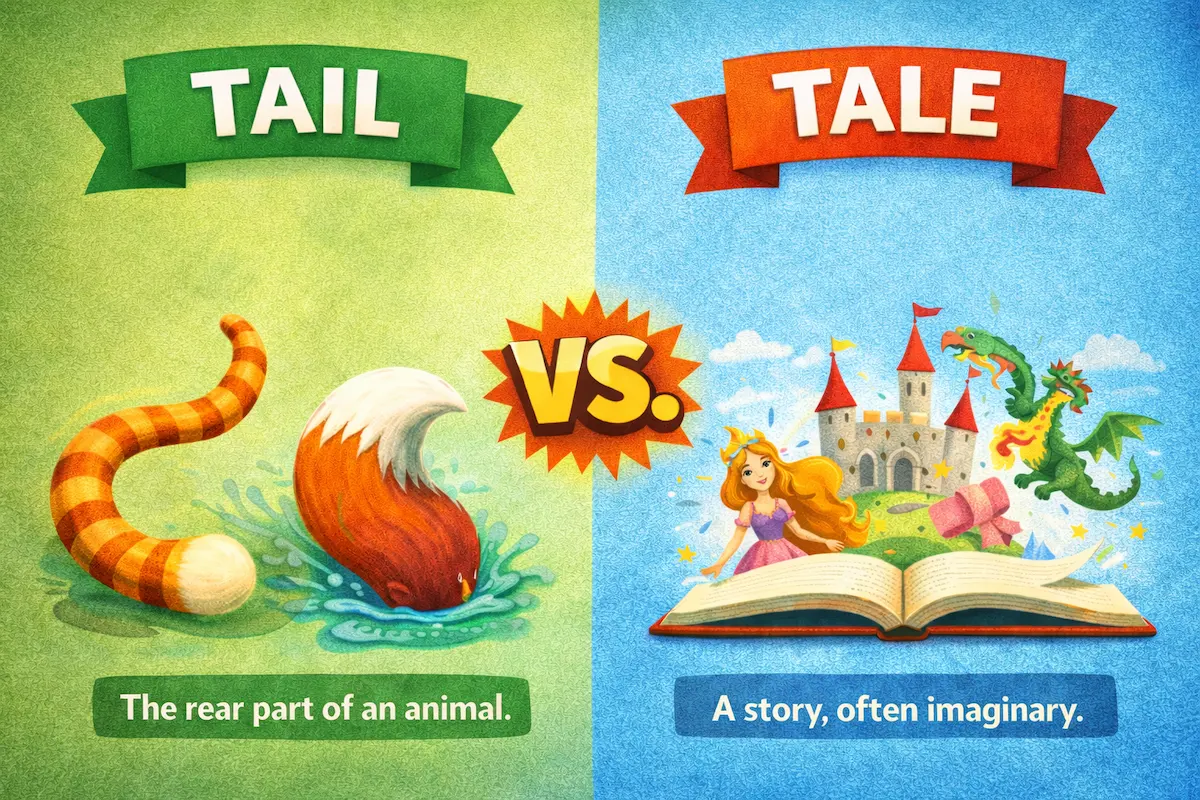
This guide explains the homophones tail and tale, showing why one refers to an animal’s appendage and the other to a story. Learn the “E for Epic” memory trick, see clear examples, and test yourself to avoid common writing mistakes.
English is full of words that sound exactly the same but mean completely different things. These words are called homophones, and they are one of the most common sources of confusion in writing — especially for learners and creative writers.
A classic example is tail and tale. One belongs to animals, the other belongs to stories. Yet because they sound identical, many writers accidentally swap them — sometimes with hilarious results.
In this confusing words guide, you’ll learn the difference between tail and tale, how to remember them instantly using a simple memory trick, and how to avoid embarrassing mistakes in both everyday writing and creative storytelling.
What Are Homophones?
Homophones are words that:
- Sound the same
- Have different spellings
- Have different meanings
Tail and tale are perfect examples of why sound alone is not enough to choose the correct word.
What Does “Tail” Mean?
Tail refers to the physical appendage at the back of an animal’s body. It is a concrete, visible, and measurable thing.
The dog wagged its tail when it saw its owner.
Tails can also appear metaphorically to mean the end or rear of something.
The cyclists rode at the tail of the group.
Common Uses of “Tail”
- An animal’s body part
- The back or end of something
- A following position
“Tail” is always physical or positional in nature.
What Does “Tale” Mean?
Tale refers to a story, narrative, or account — often imaginative or dramatic.
She told a fascinating tale about her travels.
Tales are not physical objects. They exist in language, imagination, and literature.
Common Uses of “Tale”
- Fictional stories
- Folklore and myths
- Personal narratives
Fairy tales are often told to children before bedtime.
Why Tail and Tale Are So Easily Confused
The confusion exists because:
- They are pronounced the same
- Both are common everyday words
- Spellcheck won’t catch the error
This makes them especially dangerous in writing.
The “E for Epic” Memory Trick
Here’s an easy way to remember:
Tale → E for Epic, Entertainment, Epic story
If it’s a story, it has an E.
Tail → Think of an animal’s tail (no E).
Visualizing the Difference
Visualization helps memory.
- Tail → picture a dog wagging
- Tale → picture a book or storyteller
If you can see it physically, it’s probably a tail.
Tail in Idioms and Expressions
“Tail” appears in several idiomatic expressions.
Tail between one’s legs
This phrase suggests shame or embarrassment — again referencing the physical body part.
Tale in Literature and Culture
“Tale” has strong literary associations.
A tale of love and loss
The word immediately signals storytelling.
Why Writers Must Be Extra Careful
Mixing these words can accidentally create absurd images.
❌ The dog told a long tail. ✅ The dog had a long tail.
Or:
❌ He wagged his tale happily. ✅ He told his tale happily.
Tail vs Tale in Creative Writing
In fiction, the difference matters even more.
A single wrong homophone can pull readers out of the story and damage credibility.
Grammatical Roles
Both words function as nouns, which makes confusion easier.
- Tail → noun (physical object)
- Tale → noun (story)
How Native Speakers Choose Instantly
Native speakers don’t think about spelling rules — they think about meaning.
Asking one simple question helps:
Can I touch it? → tail Can I read it? → tale
Common Learning Mistakes
- Writing by sound alone
- Skipping proofreading
- Overreliance on spellcheck
Why Spellcheck Won’t Save You
Both “tail” and “tale” are correct English words.
That means spellcheck sees no error — only human awareness can fix it.
Practice Test
Please answer the following questions. To see the correct answer, please click the arrow icon.
The cat flicked its ____ when it heard a noise.
Answer: tail Explanation: It refers to a physical body part.
She wrote a magical ____ about dragons and heroes.
Answer: tale Explanation: A story uses the word with “E”.
Which word belongs to literature: tail or tale?
Answer: tale Explanation: It refers to storytelling.
Which sentence is correct? A) The dog wagged its tale. B) The dog wagged its tail.
Answer: B Explanation: Wagging applies to a physical tail.
What does the “E for Epic” trick help you remember?
Answer: That “tale” is a story. Explanation: The letter E links tale to epic storytelling.
Final Thoughts: Stories Aren’t Body Parts
Tail and tale may sound the same, but they live in completely different worlds — one in nature, the other in imagination.
By focusing on meaning instead of sound and using simple memory tricks, you can master this homophone pair and write with greater confidence, clarity, and creativity.