"Fruit" or "Fruits"? The Plural Form of Nature’s Candy
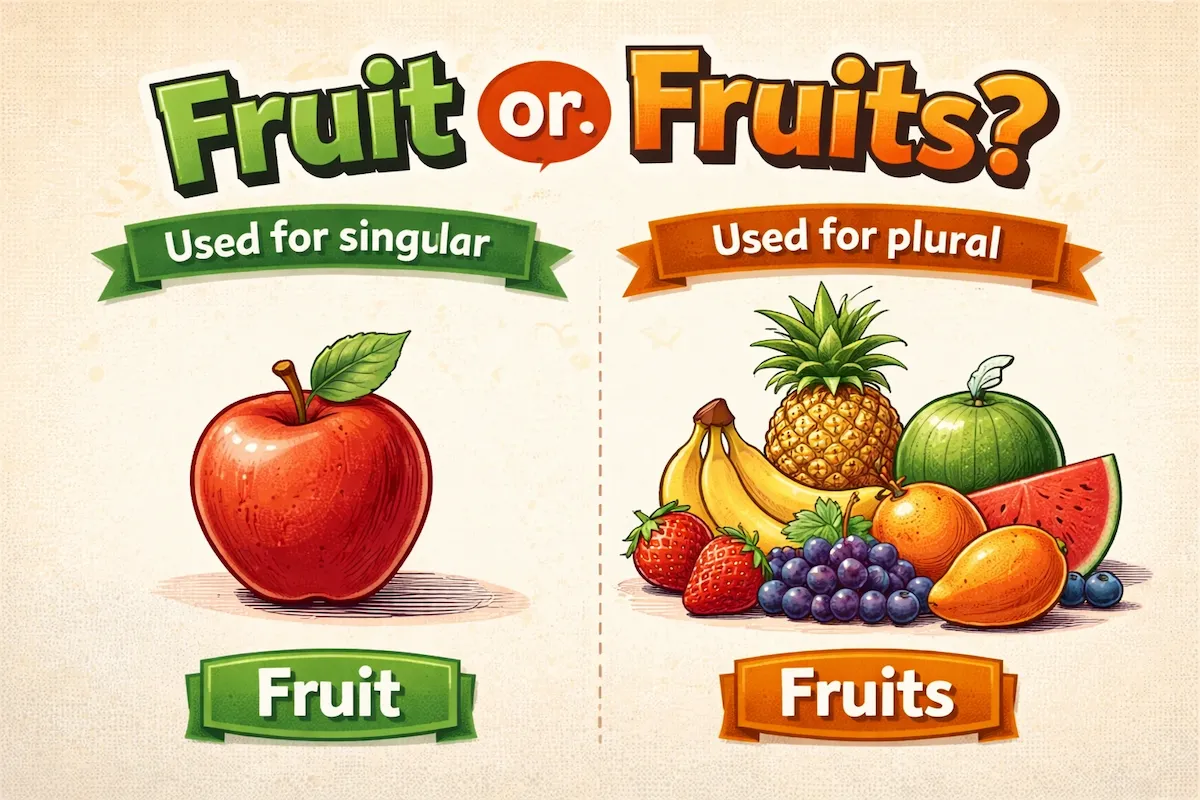
This sentence-patterns guide explains the difference between fruit and fruits. Learn how English treats fruit as a collective noun, when the plural form highlights variety, and how choosing the right form improves clarity and fluency in everyday and formal contexts.
Few English words confuse learners as much as nouns that seem plural, but sometimes aren’t. One of the most common examples is fruit. You hear people say “fruit is healthy,” but you also see signs that say “fresh fruits available.” So which one is correct?
The short answer is: both are correct — but they are used in different sentence patterns and express different ideas. The longer answer is more interesting, because it reveals how English handles collective nouns, variety, and categorization.
In this usage guide, you’ll learn the grammatical difference between fruit and fruits, how native speakers choose between them, and how meaning changes when English shifts from a collective concept to a focus on individual types. By the end, you’ll know exactly which form sounds natural in any context.
The Core Rule in Simple Terms
Fruit → collective noun (general concept) Fruits → plural noun (different kinds or varieties)
This distinction drives almost every correct usage.
What Does “Fruit” Mean?
Fruit is usually an uncountable or collective noun.
It refers to fruit as:
- A food category
- A general substance
- A nutritional group
Fruit is an important part of a healthy diet.
Here, fruit is treated like “food” or “water” — a broad concept.
Fruit as a Mass or Collective Noun
When English speakers talk about fruit in general, they almost always use the singular form.
This store sells fresh fruit. Too much fruit can upset your stomach.
Even though multiple apples or bananas are involved, the noun stays singular.
Why “Fruit” Often Takes a Singular Verb
Because fruit is treated as a collective idea, it usually takes a singular verb.
Fruit is expensive this season.
This pattern surprises learners, but it’s completely natural to native speakers.
When “Fruit” Can Be Countable
In some contexts, fruit can be countable, especially in agriculture or biology.
Each fruit was carefully inspected.
Here, “fruit” refers to individual items, not the category.
What Does “Fruits” Mean?
Fruits is the plural form and is used when the speaker wants to emphasize variety or different types.
The market sells tropical fruits.
The focus is on multiple kinds, not fruit as a general substance.
Fruits and Variety
You’ll often see fruits when listing or categorizing.
Citrus fruits include oranges, lemons, and limes.
The plural highlights diversity.
Fruit vs Fruits in Daily Conversation
In everyday speech, native speakers tend to prefer fruit.
I need to buy some fruit.
Saying “some fruits” here would sound unusual unless you’re emphasizing types.
Fruit vs Fruits in Writing
In writing, especially descriptive or educational text, both forms appear frequently.
Fruit provides essential vitamins. Fruits vary in color, texture, and taste.
Writers choose based on focus.
Common Learner Mistake #1
Incorrect: I eat fruits every day. Better: I eat fruit every day.
The daily habit refers to the general category, not types.
Common Learner Mistake #2
Incorrect: Fruit are healthy. Correct: Fruit is healthy.
Collective nouns often take singular verbs.
When “Fruits” Is the Better Choice
Use fruits when:
- You are comparing varieties
- You are categorizing types
- You want to sound specific
Exotic fruits are becoming more popular.
Fruit in Idiomatic Expressions
English idioms almost always use the singular form.
The fruit of hard work. Forbidden fruit.
These expressions treat fruit as a symbolic concept.
Fruit vs Fruits in Formal Contexts
In scientific or legal writing, fruits may appear more often.
The fruits of the research were documented.
Here, “fruits” metaphorically means results or outcomes.
Collective Nouns and Similar Patterns
Fruit behaves like:
- Food
- Furniture
- Equipment
These nouns usually stay singular even when referring to many items.
Using Quantifiers with Fruit
Because fruit is often uncountable, we use quantifiers.
Some fruit A lot of fruit A piece of fruit
These structures sound more natural than forcing a plural.
Sentence Pattern Comparison
Fruit is available all year. Fruits are displayed by region.
The verb changes with the noun form.
Practice Test
Please answer the following questions. To see the correct answer, please click the arrow icon.
Which sentence is more natural: “I eat fruit every day” or “I eat fruits every day”?
Answer: I eat fruit every day. Explanation: Daily habits refer to the general category.
Which form emphasizes variety?
Answer: fruits Explanation: The plural highlights different types.
Which sentence is correct: “Fruit are healthy” or “Fruit is healthy”?
Answer: Fruit is healthy. Explanation: Fruit is a collective noun.
Can “fruit” ever be countable?
Answer: Yes. Explanation: In biology or technical contexts, it can refer to individual items.
Why This Distinction Improves Fluency
Choosing between fruit and fruits correctly signals strong grammatical awareness.
Native speakers may not consciously explain the rule, but they hear the difference immediately.
Final Thoughts: One Word, Two Perspectives
English allows the same concept to be framed differently depending on focus.
Use fruit for the general idea. Use fruits when variety matters.
Once you understand this shift, your sentence patterns will feel more natural and more precise.