5 "Gerund vs. Infinitive" Patterns That Change the Meaning Completely
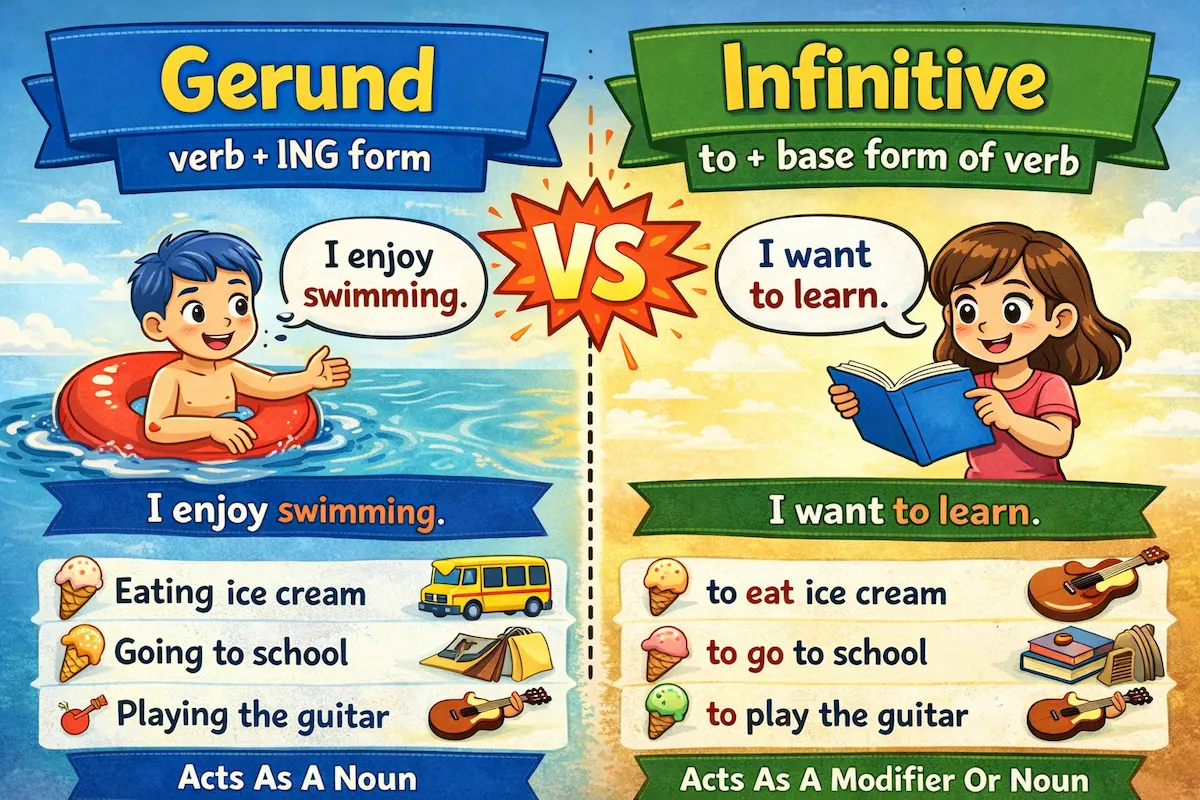
This guide explains five gerund vs infinitive patterns where meaning changes completely. Learn the difference between forms like “stop doing” and “stop to do” with clear explanations, real examples, and interactive practice tests to master English sentence patterns.
Few grammar topics confuse English learners more than gerunds and infinitives. At first glance, they look simple: a gerund ends in -ing, and an infinitive uses to + verb. But the real challenge appears when both forms are possible — and the meaning changes completely depending on which one you choose.
Saying “stop smoking” and “stop to smoke” uses the same words, the same verb, and the same tense — yet the meaning flips. One describes quitting a habit; the other describes taking a break to do that habit.
In this guide, you’ll learn five critical gerund vs. infinitive patterns where the verb form changes the story. These patterns appear constantly in daily conversation, exams, business English, and writing — and mastering them will instantly make your English more precise and natural.
Quick Refresher: Gerund vs. Infinitive
Before diving into meaning shifts, let’s quickly review:
- Gerund = verb + -ing (acts like a noun)
- Infinitive = to + base verb
Swimming is relaxing. I want to swim.
Many verbs only accept one form. But the verbs below accept both — with very different meanings.
Pattern 1: Stop Doing vs. Stop to Do
This is the most famous and most dangerous pattern.
- Stop + gerund → end an activity
- Stop + infinitive → pause one activity to start another
He stopped smoking. He stopped to smoke.
In the first sentence, smoking ended permanently. In the second, smoking is the reason he stopped doing something else.
Pattern 2: Remember Doing vs. Remember to Do
This pattern contrasts memory with responsibility.
- Remember + gerund → memory of the past
- Remember + infinitive → future responsibility
I remember locking the door. Remember to lock the door.
The first recalls an action already completed. The second is a reminder for an action not done yet.
Pattern 3: Forget Doing vs. Forget to Do
This is the negative mirror of remember.
- Forget + gerund → forget an experience
- Forget + infinitive → fail to do something
I’ll never forget meeting her. I forgot to meet her.
The first emphasizes memory. The second describes a mistake.
Pattern 4: Try Doing vs. Try to Do
This pattern separates experimentation from effort.
- Try + gerund → experiment with a method
- Try + infinitive → attempt something difficult
Try restarting the computer. Try to restart the computer.
The first suggests a possible solution. The second emphasizes effort and difficulty.
Pattern 5: Regret Doing vs. Regret to Do
This pattern is common in formal announcements.
- Regret + gerund → regret about the past
- Regret + infinitive → polite way to announce bad news
I regret saying that. We regret to inform you that your application was unsuccessful.
The infinitive version looks forward, not backward.
Why These Patterns Matter
Choosing the wrong form can:
- Change the timeline
- Change intention
- Change responsibility
- Create serious misunderstandings
In professional or academic English, these errors are noticeable.
Common Learner Mistakes
- ❌ I stopped to smoke because it was unhealthy.
- ❌ I remember to meet him last year.
- ❌ Try to restarting your phone.
These mistakes often change the meaning entirely.
A Simple Timeline Rule
Ask yourself:
- Past experience → gerund
- Future action → infinitive
This rule won’t cover every case, but it works for most.
Practice Test
Please answer the following questions. To see the correct answer, please click the arrow icon.
“She stopped ___ coffee because of her health.” (drink / to drink)
Answer: drinking. Explanation: The habit ended.
“I remembered ___ him about the meeting.” (tell / telling)
Answer: to tell. Explanation: The action was completed as a responsibility.
“Try ___ the password again.” (enter / entering)
Answer: entering. Explanation: It’s a suggested method.
“I regret ___ so late last night.” (stay / staying)
Answer: staying. Explanation: The regret is about the past.
Which form usually talks about the future?
Answer: Infinitive. Explanation: It often expresses intention or obligation.
Final Thoughts: Small Form, Big Meaning
Gerunds and infinitives aren’t just grammar choices — they shape meaning.
Mastering these five patterns will help you express time, intention, and responsibility with confidence.
When in doubt, pause and ask: Am I talking about the past, or what comes next?