Stop Saying "I Don't Know" to Your Boss – Say This Instead
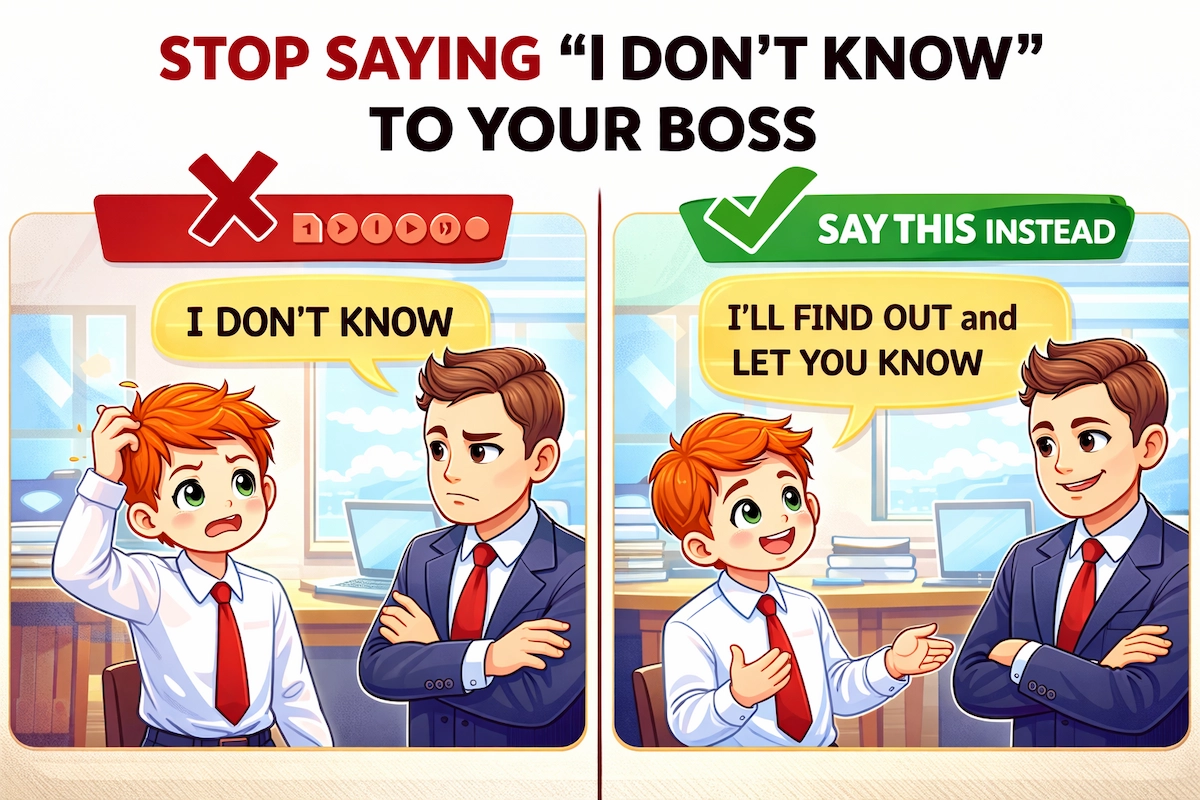
This Corporate Politeness usage guide explains why saying “I don’t know” to your boss can sound passive. Learn five professional alternatives that acknowledge uncertainty while showing ownership, initiative, and a clear plan to follow up in meetings and emails.
Saying “I don’t know” at work feels honest — and it is. But in professional environments, especially when speaking to a manager or senior leader, those three words can quietly damage how prepared, reliable, or proactive you appear.
The problem isn’t ignorance. Every professional encounters questions they can’t answer immediately. The real issue is how uncertainty is communicated. A flat “I don’t know” sounds final, passive, and disconnected from responsibility — even if that’s not what you mean.
In this usage guide, you’ll learn why “I don’t know” often lands poorly in corporate settings and discover five professional alternatives that acknowledge uncertainty while demonstrating ownership, initiative, and problem-solving mindset.
Why “I Don’t Know” Sounds Risky at Work
In casual conversation, “I don’t know” is neutral. In the workplace, however, language is often interpreted through the lens of accountability.
When a manager asks a question, they are often looking for:
- Status awareness
- Decision readiness
- Risk assessment
- Ownership
A short “I don’t know” can unintentionally suggest disengagement or lack of preparation — even if the real situation is simply that information is still pending.
The Difference Between Honesty and Passivity
Professional communication values honesty, but it also values forward motion.
Compare these two responses:
I don’t know.
I don’t have that information yet, but I can check and update you shortly.
Both are honest. Only one shows initiative.
What Your Boss Really Wants to Hear
Managers usually don’t expect instant answers to every question. What they do expect is:
- Clarity about the current state
- Awareness of next steps
- Confidence that the issue is being handled
The alternatives below are designed to meet those expectations.
Professional Alternative #1: “I don’t have that information yet.”
This is the simplest upgrade from “I don’t know.”
I don’t have that information yet.
Adding “yet” changes everything. It implies progress and expectation, not failure.
On its own, this is already more professional — but it becomes much stronger when paired with a next step.
How to Strengthen This Response
I don’t have that information yet, but I’m checking with the team.
Now you’ve added ownership.
Professional Alternative #2: “Let me confirm that and get back to you.”
This response shifts focus from lack of knowledge to action.
Let me confirm that and get back to you.
It sounds confident, calm, and solution-oriented.
This phrase is especially effective in meetings or quick discussions.
Why This Sounds Professional
You’re not emphasizing what you don’t know — you’re emphasizing what you will do next.
Managers often appreciate this clarity.
Professional Alternative #3: “I’ll need to look into that.”
This phrase communicates that the question requires investigation, not guesswork.
I’ll need to look into that.
It signals seriousness and responsibility rather than uncertainty.
Use this when accuracy matters more than speed.
Adding a Timeframe
Whenever possible, add a time reference.
I’ll need to look into that and can update you by this afternoon.
This builds trust and manages expectations.
Professional Alternative #4: “Based on what I know so far…”
Sometimes you don’t have the full answer, but you do have partial insight.
Based on what I know so far, we’re still waiting on final confirmation.
This phrasing allows you to contribute without overcommitting.
It shows situational awareness.
Why This Is Better Than Guessing
Guessing damages credibility far more than admitting incomplete information.
This phrase balances transparency with professionalism.
Professional Alternative #5: “I don’t have the answer right now, but here’s what I can do.”
This is one of the strongest responses you can use.
I don’t have the answer right now, but here’s what I can do.
It reframes uncertainty as capability.
This phrase works well in high-stakes discussions or when expectations are high.
How to Choose the Right Alternative
Consider:
- How urgent the question is
- Who is asking
- Whether a follow-up is expected
The more senior the audience, the more valuable clarity and ownership become.
What to Avoid Saying Instead
These phrases often weaken your message:
- I’m not sure.
- No idea.
- I haven’t looked at it.
- I didn’t check.
They focus on absence of effort rather than next steps.
Written vs Spoken Responses
In emails, clarity matters even more.
I don’t have that information yet. I’ll follow up once I’ve confirmed the details.
This sounds composed and professional.
Why Proactive Language Builds Trust
Managers trust people who:
- Identify gaps early
- Communicate clearly
- Take responsibility for follow-up
Your wording plays a major role in signaling these qualities.
Practice Makes This Automatic
The goal isn’t to avoid uncertainty — it’s to express it professionally.
With practice, these alternatives become natural and effortless.
Final Thoughts: Confidence Isn’t Knowing Everything
Strong professionals aren’t defined by having every answer — they’re defined by how they respond when they don’t.
By replacing “I don’t know” with proactive, solution-focused language, you communicate reliability, maturity, and leadership potential.
Uncertainty is inevitable. Sounding unprepared doesn’t have to be.