Prepositions with "Good": "Good At" vs. "Good For"
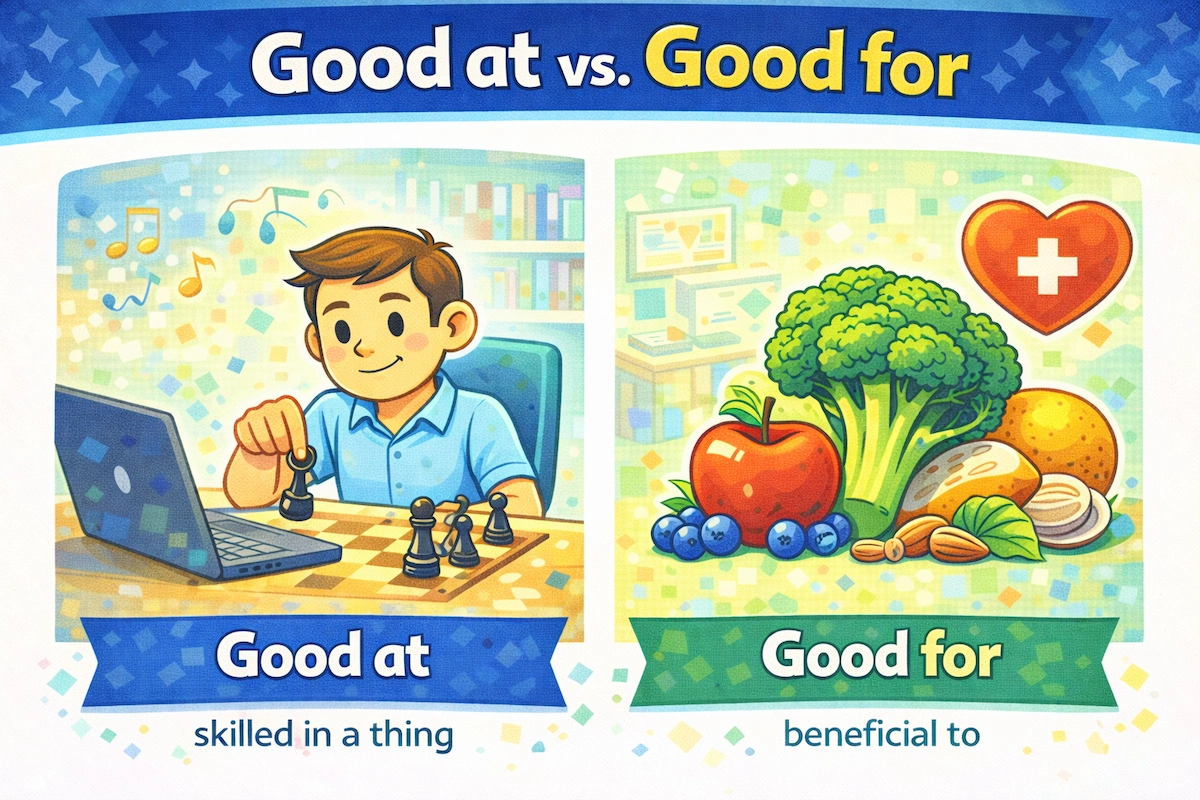
This Preposition Tips usage guide explains when to use “good at” and when to use “good for.” Learn how these adjective–preposition pairings change meaning, see real examples, avoid common mistakes, and improve fluency in both spoken and written English.
One of the easiest ways to sound more natural in English is mastering adjective–preposition pairings. Unfortunately, this is also where many learners get stuck. A perfect example is the word “good.” You’ve probably seen both “good at” and “good for,” but knowing when to use each one isn’t always obvious.
The confusion usually comes from translation. In many languages, the idea of being “good” at something and something being “good” for you uses the same structure. English separates these ideas very clearly — and choosing the wrong preposition can change the meaning of your sentence entirely.
In this usage guide, you’ll learn the difference between “good at” and “good for,” how native speakers use them in real situations, common mistakes to avoid, and simple patterns you can follow to improve fluency instantly.
Why Prepositions with “Good” Cause Problems
The adjective good is extremely flexible. It can describe skill, benefit, quality, morality, or usefulness. The preposition that follows tells us which meaning is intended.
Compare these two sentences:
She’s good at math.
Math is good for her.
Both sentences are correct, but they communicate very different ideas. Understanding that difference is the key to using these phrases correctly.
What Does “Good At” Mean?
“Good at” is used to describe ability, skill, or performance. It answers the question: What can someone do well?
When you use good at, you are talking about competence — not benefit.
He’s good at explaining complex ideas in simple terms.
She’s very good at negotiating with clients.
In both cases, the focus is on skill and effectiveness.
Common Patterns with “Good At”
Good at is commonly followed by:
- Nouns (good at math, good at leadership)
- Gerunds (good at speaking, good at problem-solving)
- Activities or tasks
He’s good at handling difficult conversations.
I’m not very good at remembering names.
Notice how good at is almost always connected to something you do.
What Does “Good For” Mean?
“Good for” is used to describe benefit, advantage, or positive effect. It answers the question: What does this help? or Who does this benefit?
Here, the focus is not on skill, but on outcome.
Exercise is good for your mental health.
This experience will be good for your career.
In both cases, good for highlights a positive result.
Common Patterns with “Good For”
Good for is often followed by:
- People (good for you, good for children)
- Health or well-being (good for your heart)
- Goals or outcomes (good for growth, good for business)
Reading regularly is good for your vocabulary.
That decision might be good for the company in the long run.
Think of good for as focusing on results rather than abilities.
Side-by-Side Comparison
Looking at both phrases together makes the difference clearer:
- Good at → skill or ability
- Good for → benefit or positive effect
She’s good at teaching. Teaching is good for her confidence.
The first sentence talks about skill. The second talks about impact.
Common Mistake #1: Using “Good At” for Benefits
A frequent learner mistake is using good at when talking about health or advantages.
Incorrect:
This diet is good at your body.
Correct:
This diet is good for your body.
Remember: if the sentence answers “Who or what benefits?”, use good for.
Common Mistake #2: Using “Good For” for Skills
Another common error is using good for when describing ability.
Incorrect:
She’s good for public speaking.
Correct:
She’s good at public speaking.
If you can replace the phrase with “skilled at,” then good at is the correct choice.
Questions with “Good At” and “Good For”
Questions often make the difference clearer.
What are you good at?
What is this good for?
The first asks about ability. The second asks about purpose or benefit.
Using “Good At” and “Good For” in Professional English
In workplace communication, these phrases appear frequently.
He’s good at managing cross-functional teams.
This role will be good for your long-term development.
Mixing them up in professional contexts can cause confusion or sound unnatural.
Negative Forms
Both phrases work naturally in negative form.
I’m not very good at multitasking.
Too much sugar is not good for your health.
Notice that the structure stays the same — only the meaning changes.
Related Expressions
English also uses similar patterns with other adjectives:
- Bad at / bad for
- Great at / great for
- Useful for
- Skilled at
Learning good at vs. good for makes it easier to master these patterns as well.
Simple Memory Trick
Use this quick test:
- If you can replace it with skilled at → use good at
- If you can replace it with beneficial to → use good for
This shortcut works in most real-world situations.
Final Thoughts: Small Prepositions, Big Difference
Good at and good for may look similar, but they express completely different ideas. One is about ability. The other is about benefit.
Mastering these adjective–preposition pairings helps your English sound more accurate, confident, and natural — especially in speaking and writing.
When you stop guessing and start choosing prepositions with intention, fluency follows.