"Amount" vs. "Number" – Grammar Rules for Mass and Count Nouns
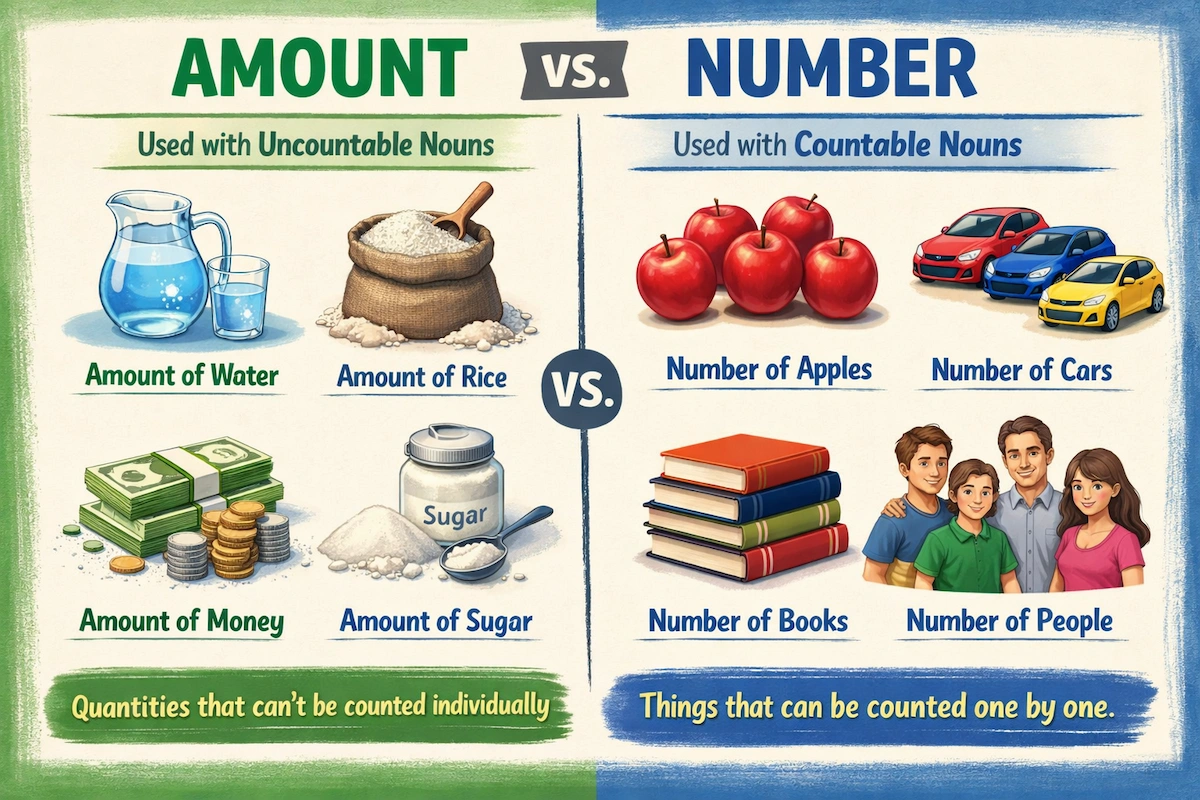
This common-mistakes usage guide explains the difference between “amount” and “number.” Learn how mass nouns and count nouns work, see common errors, and master a simple rule to describe quantities accurately in spoken and written English.
Few grammar mistakes are as common — and as easy to avoid — as confusing amount and number. Both words are used to talk about quantity, and in casual conversation, people often mix them up without being corrected. But in correct English, these two words follow a very clear rule.
Saying “the amount of people” or “a number of water” may still be understood, but it immediately signals non-native usage and can weaken your writing, especially in academic, professional, or formal contexts.
In this usage guide, you’ll learn the exact difference between amount and number, how they relate to mass nouns and count nouns, why the mistake happens so often, and how to choose the correct word every time — without memorizing long grammar rules.
The Core Rule (Memorize This First)
Here is the rule that solves most problems:
Use amount with uncountable (mass) nouns. Use number with countable nouns.
Everything else in this guide explains why this rule exists and how to apply it naturally.
What Is a Mass (Uncountable) Noun?
A mass noun refers to something that cannot be counted individually.
These nouns:
- Do not have a plural form
- Are measured, not counted
- Often describe substances or abstract concepts
water, information, money, furniture, advice
You don’t say “two waters” or “three informations” in standard English.
Why We Use “Amount” with Mass Nouns
Because mass nouns cannot be counted directly, English uses amount to describe their quantity.
A large amount of water was wasted.
The focus is on volume or degree, not individual units.
What Is a Count Noun?
A count noun refers to something that can be counted as individual items.
These nouns:
- Have singular and plural forms
- Can be used with numbers
- Represent separate objects or people
bottle → bottles person → people idea → ideas
Why We Use “Number” with Count Nouns
Since count nouns can be counted, English uses number to describe how many there are.
A large number of bottles were recycled.
Each bottle is a separate, countable unit.
Amount vs Number: Side-by-Side Comparison
Correct: The amount of traffic was unexpected. Correct: The number of cars was unexpected.
Traffic is uncountable; cars are countable.
Why This Mistake Is So Common
Learners often confuse amount and number because:
- Many languages use one word for both
- Spoken English sometimes ignores the rule
- The difference feels abstract
However, written English — especially professional or academic — strongly prefers the correct form.
Common Learner Mistake #1
Incorrect: A large amount of people attended. Correct: A large number of people attended.
“People” is plural and countable.
Common Learner Mistake #2
Incorrect: A number of water was spilled. Correct: An amount of water was spilled.
“Water” cannot be counted directly.
What About “A Lot Of”?
A lot of works with both mass and count nouns.
A lot of water was used. A lot of bottles were used.
This makes it useful in casual speech — but it lacks precision in formal writing.
Formal Writing vs Casual Speech
In spoken English, people sometimes say:
The amount of people here is crazy.
While common, this is considered incorrect in formal contexts.
In writing, exams, reports, or presentations, always follow the rule.
Special Case: Collective Nouns
Some nouns feel singular but behave like count nouns.
The number of staff has increased.
Even though “staff” feels collective, it refers to people and uses number.
Amount and Number in Comparisons
Both words are often used in comparative structures.
The amount of time required is less than expected. The number of errors has decreased.
The noun following the phrase determines the choice.
A Simple Test You Can Use
Ask yourself:
Can I count it with numbers?
If yes → use number. If no → use amount.
Practice Test
Please answer the following questions. To see the correct answer, please click the arrow icon.
Which is correct: a large ___ of information?
Answer: amount Explanation: Information is an uncountable noun.
Which is correct: a small ___ of mistakes?
Answer: number Explanation: Mistakes can be counted individually.
Which word fits: the ___ of money spent was surprising?
Answer: amount Explanation: Money is treated as a mass noun.
Which word fits: the ___ of emails increased overnight?
Answer: number Explanation: Emails are countable items.
Why This Rule Matters
Correctly using amount and number improves:
- Clarity
- Professional tone
- Grammatical accuracy
Small mistakes often carry big signals about language proficiency.
Final Thoughts: Count or Measure?
The difference between amount and number is not about vocabulary — it’s about how English views objects and substances.
Once you train yourself to see nouns as countable or uncountable, the correct choice becomes automatic.
Master this rule, and you eliminate one of the most common grammar mistakes in English.