"Me and My Friend" – Why This Common Subject Error Matters
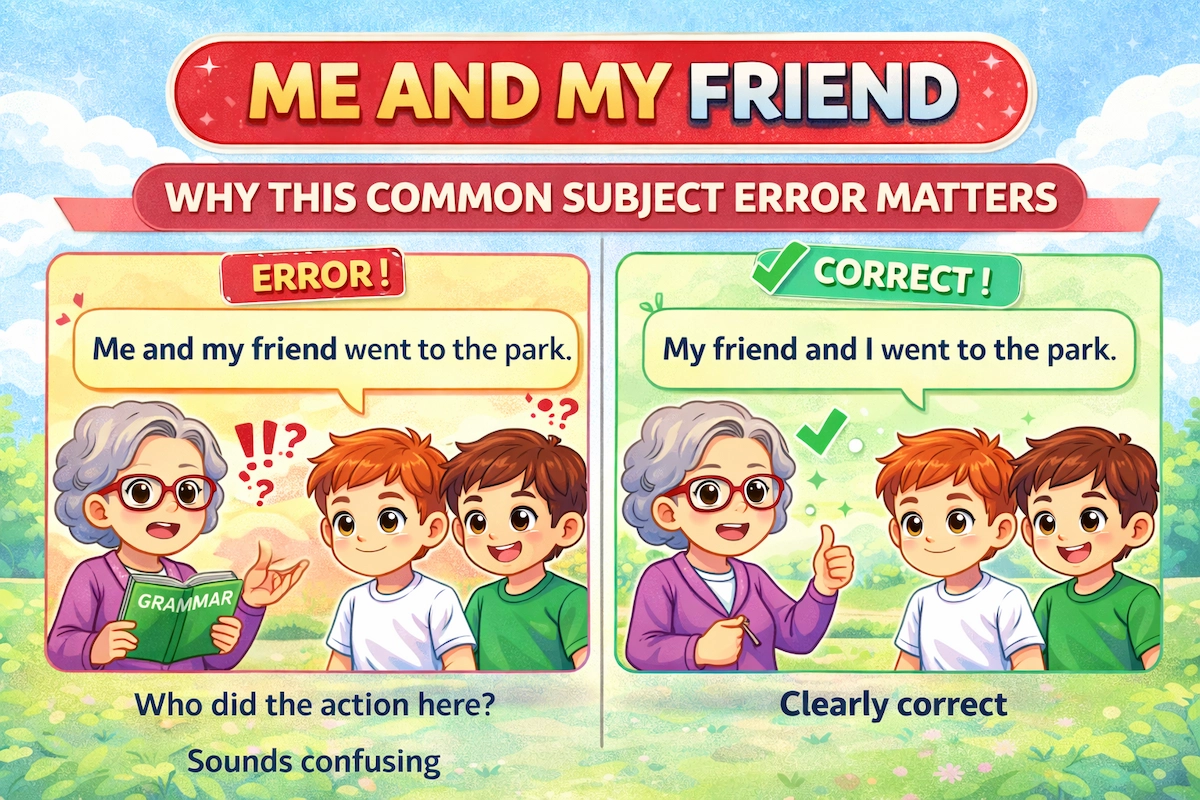
This common-mistakes usage guide explains the difference between “me and my friend” and “my friend and I.” Learn how subject and object pronouns work, why this error matters in professional English, and how to check your sentences instantly using a simple grammar test.
You’ve probably heard — or even said — the phrase “me and my friend” in English. It sounds natural, casual, and extremely common in everyday speech. But when this phrase appears as the subject of a sentence, it creates one of the most frequent grammatical mistakes in English.
The issue isn’t politeness or word order. It’s about pronoun case — specifically, knowing when to use I and when to use me. This small difference has a surprisingly big impact on how correct, educated, and fluent your English sounds.
In this usage guide, we’ll explain why “My friend and I” is the correct subject form, why “me and my friend” sounds wrong in formal English, and how you can instantly check your sentences for pronoun errors — without memorizing complicated grammar rules.
Why This Mistake Is So Common
Many English learners — and even native speakers — make this mistake because spoken English is often more relaxed than written English.
In conversation, people frequently say:
Me and my friend went to the mall.
Native speakers understand the meaning instantly, so the sentence feels “acceptable.” However, from a grammatical perspective, this sentence contains a clear subject error.
Understanding Subject vs Object Pronouns
English pronouns change form depending on their role in a sentence.
Subject pronouns perform the action:
- I
- You
- He
- She
- We
- They
Object pronouns receive the action:
- Me
- You
- Him
- Her
- Us
- Them
The key point: “me” is never a subject.
Why “Me and My Friend” Is Incorrect as a Subject
Let’s simplify the sentence:
Me went to the mall.
That sentence clearly sounds wrong. When you add “my friend,” the error becomes harder to hear — but it doesn’t disappear.
Me and my friend went to the mall.
Grammatically, the subject still contains me, which is incorrect.
The Correct Form: “My Friend and I”
When the phrase is the subject of the sentence, you must use I.
My friend and I went to the mall.
If you remove “my friend,” the sentence still works:
I went to the mall.
This is the clearest sign that the pronoun is correct.
The Simple Grammar Test (Use This Every Time)
Here’s the fastest way to check your sentence:
Remove the other person and test the pronoun alone.
Me went home ❌ I went home ✅
If I works by itself, then my friend and I is correct.
When “Me and My Friend” Is Actually Correct
Me is correct when it’s an object.
She invited me and my friend to the party.
Test it again:
She invited me.
That sentence works, so me is correct here.
Subject vs Object: Side-by-Side
Subject: My friend and I are working late. Object: The manager thanked me and my friend.
Same people, different pronouns — because the grammatical role changes.
Why Word Order Matters Too
In polite English, speakers usually place themselves after the other person.
My friend and I ✔ I and my friend ❌ (grammatical, but unnatural)
This isn’t about grammar — it’s about convention and politeness.
Why This Error Matters in Professional English
While this mistake is common in casual speech, it stands out in:
- Emails
- Presentations
- Academic writing
- Job applications
Using the wrong pronoun can make your writing look careless — even if your ideas are strong.
Native Speakers Make This Mistake Too
It’s important to know that many native speakers say “me and my friend” when speaking casually.
However, they instinctively switch to “my friend and I” in formal contexts.
As a learner, mastering the correct form gives you an advantage.
Common Learner Mistake #1
Incorrect: Me and my friend is working today. Correct: My friend and I are working today.
Common Learner Mistake #2
Incorrect: The teacher spoke to my friend and I. Correct: The teacher spoke to me and my friend.
Here, I is incorrect because it’s the object.
Why “and I” Is Sometimes Overused
Some learners overcorrect and use I everywhere.
Incorrect: This gift is from my friend and I.
The test reveals the issue:
This gift is from I ❌ This gift is from me ✅
Quick Reference Rule
- Subject → I
- Object → me
Always test the pronoun alone.
Why Teachers Emphasize This Rule
This structure appears everywhere in English — stories, emails, conversations, and exams.
Mastering it improves both clarity and confidence.
Final Thoughts: Small Grammar, Big Impact
“Me and my friend” may sound casual and friendly, but in formal English, it’s a grammatical red flag.
By learning when to use “my friend and I” and when to use “me and my friend”, you eliminate a mistake that even native speakers struggle with.
One simple test. Instant accuracy.