"Between" vs. "Among" – The "Two vs. Many" Myth
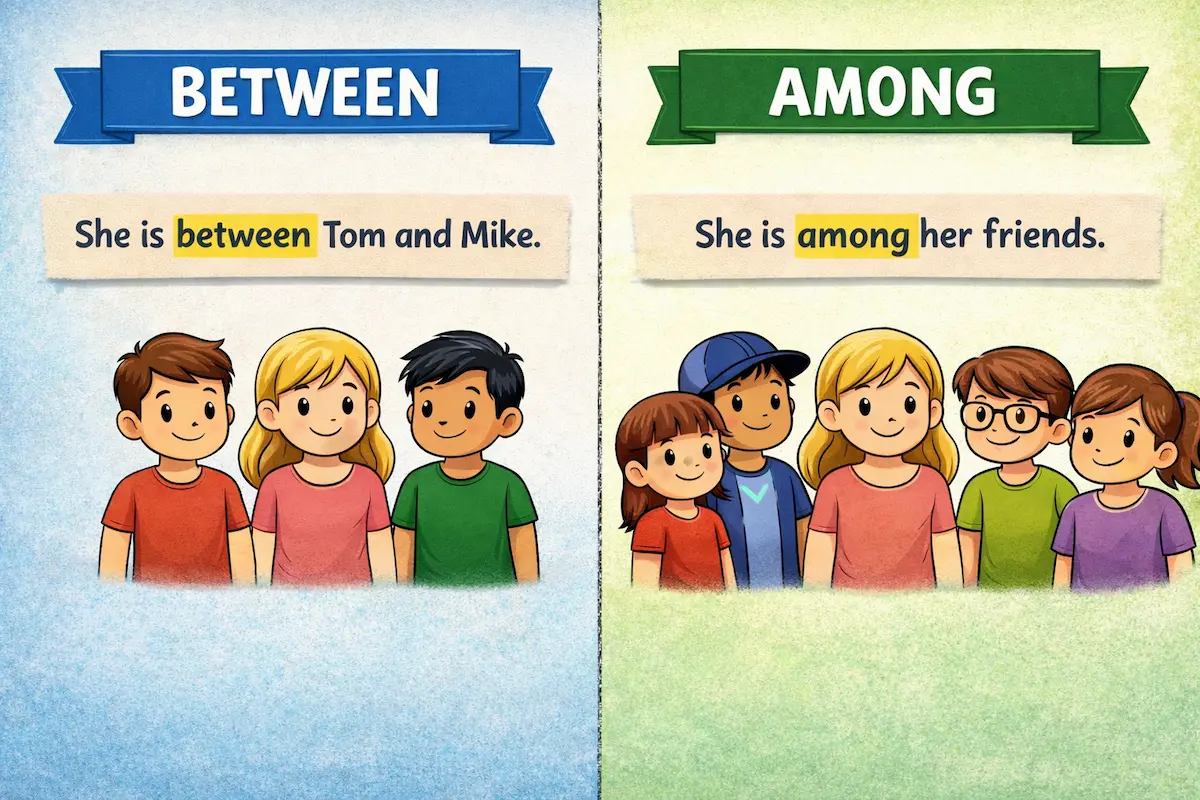
Still following the “two vs. many” rule for between and among? This guide explains the real difference: individual relationships versus group belonging. Learn when “between” works for more than two items and when “among” is the only correct choice.
Many English learners are taught a simple rule: Use “between” for two things and “among” for more than two.
While this rule is helpful at a beginner level, it is not entirely accurate. In real English usage, the difference between “between” and “among” is more about relationships and structure than about counting numbers.
In this complete guide, we will go beyond the “two vs. many” myth and explore the deeper logic behind these two prepositions. By the end, you’ll understand when “between” can be used for more than two items — and when “among” is clearly the correct choice.
The Traditional Rule: Two vs. More Than Two
The classic explanation says:
- Between → used for two items
- Among → used for three or more items
She sat between John and Maria. He divided the candy among the children.
In these examples, the rule works perfectly. But English is rarely that simple.
The Real Rule: Individual Relationships vs. Group Membership
The key difference is not about numbers — it is about how the items relate to each other.
Use “Between” When Individual Relationships Are Clear
“Between” is used when we see distinct, separate items with clear boundaries, even if there are more than two.
The negotiations between the United States, China, and Japan continued for weeks.
There are three countries here, but each relationship is distinct.
She had to choose between studying law, medicine, or engineering.
Again, more than two choices — but each option is separate and clearly defined.
Use “Among” for Groups or Collective Contexts
“Among” is used when something is part of a group or surrounded by many members without clear individual pairing.
She felt comfortable among friends. The secret was shared among the team members.
In these cases, we are not focusing on one-to-one relationships, but on belonging within a group.
Why “Between” Can Be Used for More Than Two
If the relationship is structured and individual, “between” works even with multiple parties.
A treaty was signed between the five nations.
Even though there are five nations, each one is individually connected.
Common Mistakes
Mistake 1: Overusing “Among” for Numbers
❌ The contract was signed among the three companies. ✔ The contract was signed between the three companies.
Because contracts create specific relationships, “between” is correct.
Mistake 2: Using “Between” for General Belonging
❌ She felt happy between her classmates. ✔ She felt happy among her classmates.
This situation describes group belonging, not individual relationships.
Abstract Uses
“Between” is often used for contrast:
The difference between success and failure is preparation.
“Among” is often used for distribution:
The teacher distributed the papers among the students.
Quick Comparison
Between → distinct, separate, individual relationships Among → collective, group, shared environment
Practice Test
Please answer the following questions. To see the correct answer, please click the arrow icon.
Which is correct: "The negotiations took place ___ the three companies."
Answer: between Explanation: Negotiations involve specific parties with defined relationships.
Which is correct: "She felt relaxed ___ friends."
Answer: among Explanation: This describes belonging within a group.
Can “between” be used for more than two items?
Answer: Yes. Explanation: If the relationships are individual and distinct, “between” is correct.
Which fits: "The money was divided ___ the participants."
Answer: among Explanation: Distribution within a group calls for “among.”
Which is correct: "The difference ___ the options was clear."
Answer: between Explanation: Differences compare distinct items.
Final Takeaway: It’s About Structure, Not Numbers
Forget the simple “two vs. many” rule. Instead, ask:
- Are the relationships individual and clearly defined? → between
- Is this about being part of a group? → among
When you focus on structure instead of counting, your preposition choice becomes clear and natural.