How to End an Email: "Best" vs. "Yours faithfully"
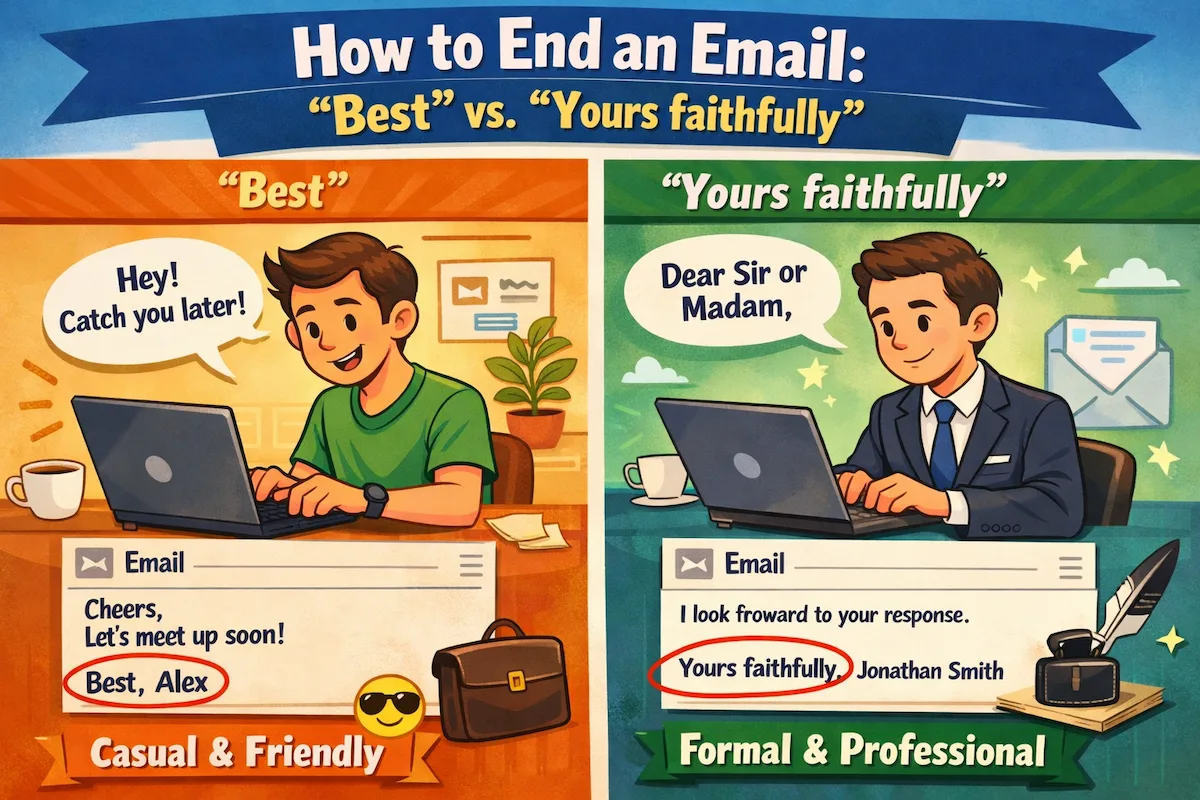
This guide explains formal and informal email closings in English. Learn when to use Best, Best regards, Yours sincerely, and Yours faithfully, avoid awkward mistakes, and choose the right sign-off for professional emails in British and American contexts.
Ending an email may seem like a small detail, but in professional English, the closing line can quietly communicate respect, distance, warmth, or even awkwardness. A well-written email can instantly feel wrong if it ends with the wrong sign-off.
Should you write “Best”? “Best regards”? “Yours sincerely”? Or “Yours faithfully”? These choices are not interchangeable, and using the wrong one can make you sound too casual, too stiff, or unfamiliar with professional norms.
In this guide, we’ll break down formal vs informal email closings, explain when to use each option, and help you choose the right sign-off for any professional situation with confidence.
Why Email Closings Matter More Than You Think
In spoken conversation, tone and body language soften mistakes. In emails, you only have words — and the closing is the final emotional signal.
A closing can suggest:
- Professional distance
- Politeness and respect
- Friendliness or warmth
- Formality or authority
That’s why choosing between “Best” and “Yours faithfully” matters.
Understanding the Formal–Informal Spectrum
Email sign-offs exist on a spectrum, not in two simple boxes.
Very formal → Neutral professional → Friendly informal
Knowing where your relationship sits on this spectrum is the key to choosing the right closing.
What Does “Best” Mean?
“Best” is one of the most common modern email closings.
Best, Alex
It’s short, friendly, and efficient. It suggests professionalism without emotional distance.
When “Best” Is Appropriate
- Emails to colleagues
- Ongoing professional relationships
- Internal company communication
- Informal client emails
“Best” works well when the relationship already exists.
When “Best” Can Sound Wrong
Avoid “Best” when:
- Writing a formal complaint
- Contacting someone for the first time
- Writing to an unknown recipient
- Sending legal or official correspondence
In these cases, “Best” may sound too casual.
What Does “Yours faithfully” Mean?
“Yours faithfully” is a traditional, highly formal British English closing.
Yours faithfully, Alex Turner
It signals formality, respect, and professional distance.
The Golden Rule: Faithfully vs Sincerely
This is one of the strictest rules in formal email writing.
- If you don’t know the recipient’s name → use Yours faithfully
- If you do know the recipient’s name → use Yours sincerely
Dear Sir or Madam, Yours faithfully,
Dear Ms. Johnson, Yours sincerely,
Why This Rule Exists
“Faithfully” implies loyalty to a role or institution.
“Sincerely” implies a direct, personal connection.
Mixing them breaks convention and can signal inexperience.
Best Regards: The Middle Ground
“Best regards” sits comfortably between formal and informal.
Best regards, Alex
It’s polite, safe, and widely accepted in international business.
Comparing Common Closings
- Yours faithfully → very formal
- Yours sincerely → formal
- Best regards → neutral professional
- Best → informal professional
- Thanks → casual
American vs British Usage
In American English, “Yours faithfully” is rare.
Americans often prefer:
- Sincerely
- Best regards
- Best
In British English, “Yours faithfully” remains standard for formal letters.
Email Closings to Avoid
- Love (in professional emails)
- XOXO
- Cheers (in formal contexts)
- Warmest wishes (unless appropriate)
Matching the Closing to the Email Tone
Your sign-off should match:
- The opening
- The email content
- Your relationship with the reader
A formal email ending casually creates imbalance.
Practice Test
Please answer the following questions. To see the correct answer, please click the arrow icon.
You write to an unknown company contact. Which closing is correct?
Answer: Yours faithfully. Explanation: The recipient’s name is unknown.
You email a colleague you work with daily. Which closing fits best?
Answer: Best. Explanation: The relationship is informal-professional.
Is “Best regards” formal or informal?
Answer: Neutral professional. Explanation: It sits between formal and informal.
Should “Yours faithfully” be used in American business emails?
Answer: Usually no. Explanation: It’s mainly British usage.
Why is choosing the right closing important?
Answer: It signals tone and professionalism. Explanation: The closing is the final impression.
Final Thoughts: End Strong, Not Awkward
Ending an email correctly isn’t about memorizing rules — it’s about awareness.
When in doubt, choose a slightly more formal option. It’s always easier to become less formal later than to recover from sounding unprofessional.
Mastering email sign-offs like “Best” and “Yours faithfully” will help your writing feel confident, appropriate, and polished in any setting.