"On Time" vs. "In Time" – Punctuality vs. Opportunity
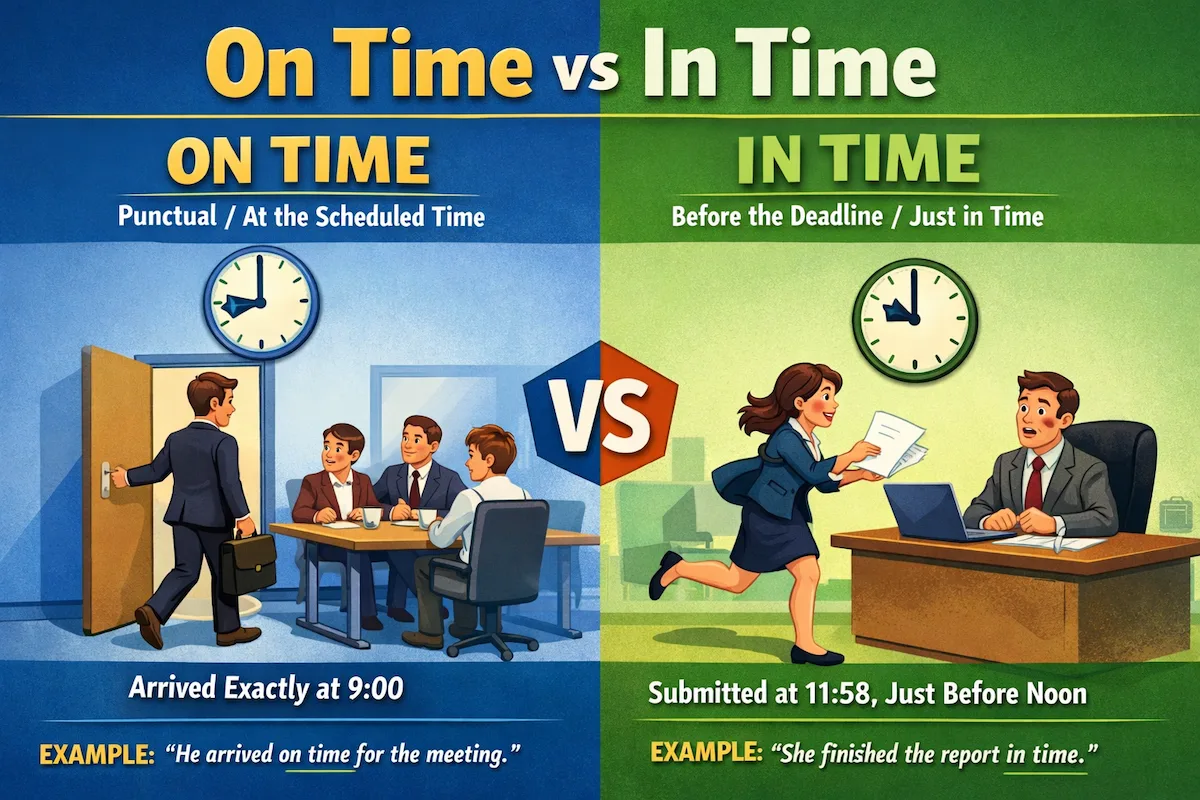
This preposition guide explains the difference between on time and in time. Learn how on time refers to schedules and punctuality, while in time focuses on deadlines, urgency, and last-minute opportunities, with clear examples and practice questions.
Few English phrases confuse learners as much as “on time” and “in time”. They look almost identical, they both involve time, and in many languages, they translate into the same expression. Yet in English, these two phrases describe completely different ideas.
Mixing them up can change the meaning of a sentence entirely. You might sound like you arrived late when you were actually punctual — or like you met a deadline when you barely avoided disaster.
In this complete preposition guide, we’ll break down the difference between on time and in time, show how native speakers use them in daily and professional contexts, and give you clear patterns you can rely on without hesitation.
The Core Difference: Schedule vs. Deadline
The easiest way to understand the difference is this:
On time → according to a schedule In time → before it is too late
These two ideas overlap in daily life, but they are not the same.
What “On Time” Really Means
On time means something happens exactly at the planned or expected time — not early, not late.
The train arrived on time.
This phrase is strongly connected to schedules, timetables, and fixed plans.
Common Situations for “On Time”
Native speakers use on time when talking about:
- Trains, buses, and flights
- Meetings and appointments
- Classes and events
Please arrive on time for the meeting.
“On Time” Does Not Mean Early
This is a common misunderstanding.
Incorrect interpretation: on time = early Correct meaning: on time = exactly when planned
If someone arrives early, we usually say early, not on time.
What “In Time” Really Means
In time means before a deadline or before something bad happens.
I arrived in time to catch the last train.
Here, the focus is not the schedule — it’s avoiding a negative outcome.
In Time Is About Opportunity
In time emphasizes opportunity, rescue, or last chances.
She submitted the report in time.
This means she met the deadline, even if it was close.
Comparing the Two Side by Side
He arrived on time for the interview. He arrived in time for the interview.
The first sentence means he arrived at the scheduled hour. The second means he arrived before it was too late — possibly just seconds before the door closed.
On Time in Professional Contexts
In business and work environments, on time often signals reliability.
The project was delivered on time.
This implies professionalism and respect for deadlines.
In Time at Work
In time in professional settings often sounds less ideal.
We finished the task in time.
This suggests pressure, urgency, or a close call.
Why Tone Matters
Compare these:
The report was submitted on time. → confident, professional The report was submitted in time. → relieved, barely successful
Both are positive, but the tone is very different.
On Time with Transport
Transport announcements almost always use on time.
Flight 308 is arriving on time.
Using “in time” here would sound strange.
In Time with Emergencies
Emergency or dramatic situations strongly favor in time.
The firefighters arrived in time to save the house.
“On time” would feel emotionally inappropriate here.
Grammar Pattern Differences
Both phrases usually appear:
- At the end of a sentence
- After the verb they modify
She finished the exam on time. He got there in time.
Negative Forms
The bus didn’t arrive on time. We didn’t arrive in time.
Notice how the second sentence implies missing an opportunity.
Common Learner Mistakes
Incorrect: I was in time for the meeting. Correct: I was on time for the meeting.
Meetings have schedules — so on time is required.
Memory Trick
A simple way to remember:
Schedule → on time Deadline / danger → in time
If there is a clock on the wall, think “on time.” If there is pressure or risk, think “in time.”
Practice Test
Please answer the following questions. To see the correct answer, please click the arrow icon.
Which phrase fits: “The train arrived ___ time.”
Answer: on time Explanation: Trains follow schedules.
Which phrase fits: “We escaped ___ time.”
Answer: in time Explanation: It focuses on avoiding danger.
Which sounds more professional: “The report was finished on time” or “in time”?
Answer: on time Explanation: It suggests proper planning and reliability.
Which phrase implies urgency?
Answer: in time Explanation: It suggests a narrow margin or last chance.
Why This Difference Matters
Mixing up these phrases can change how competent or calm you sound.
Native speakers pick up on this distinction immediately.
Final Thoughts: Precision Builds Confidence
On time is about punctuality and planning. In time is about opportunity and relief.
Once you internalize this difference, you’ll avoid one of the most common preposition mistakes — and your English will instantly sound clearer and more natural.