Shear vs. Sheer: Are You Cutting Wool or Is the Cliff Just Steep?
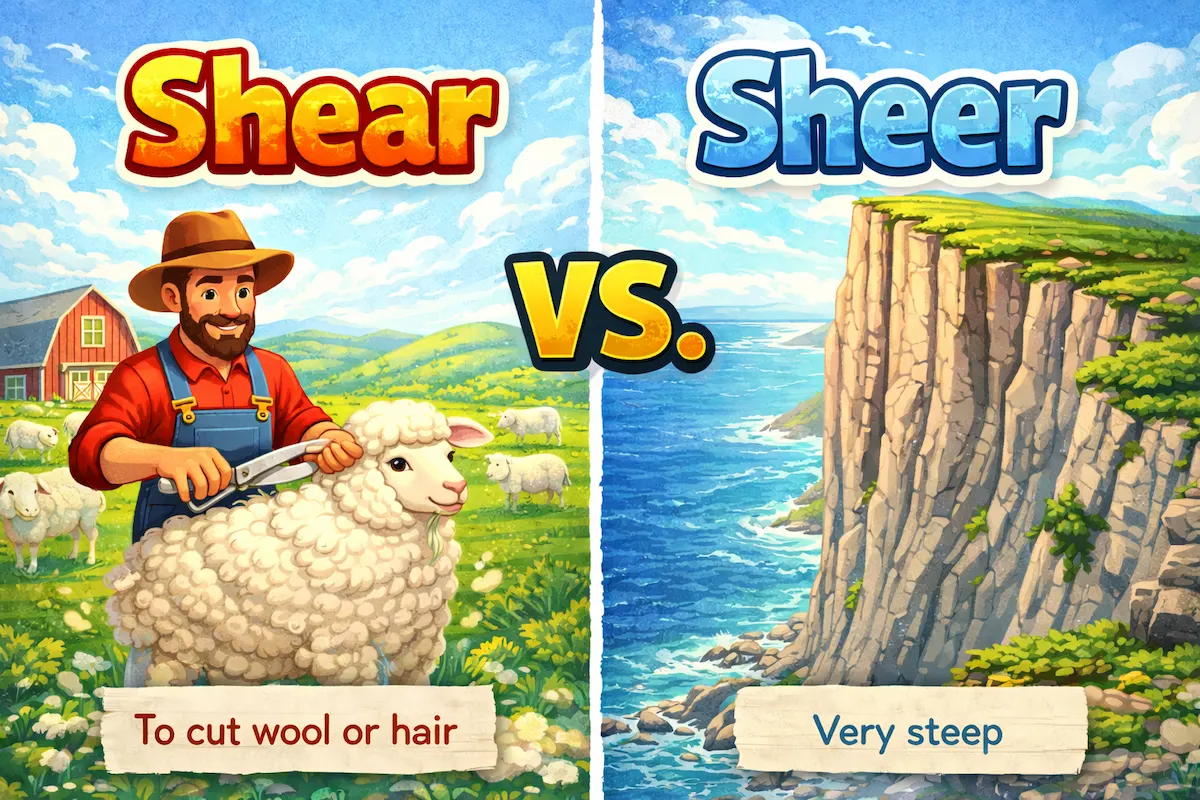
This guide explains the homophones shear and sheer with clear definitions and examples. Learn why shear means cutting and sheer describes thinness, intensity, or steepness, plus master the EA-for-action and EE-for-description memory trick.
English homophones can be tricky, but some pairs are especially confusing because they live in completely different worlds. One belongs to fashion, farming, and haircuts. The other belongs to nature, emotions, and visual description.
Shear and sheer sound exactly the same, yet their meanings could not be more different. Mix them up, and you might accidentally cut a cliff or describe a sheep as transparent.
In this confusing words guide, you’ll learn how to correctly use shear and sheer in every context, understand why one is an action and the other a description, and master an easy memory trick that makes this pair almost impossible to confuse again.
Why Shear and Sheer Are So Often Confused
The confusion exists for a simple reason: pronunciation.
In modern English, shear and sheer are pronounced identically. When speaking, context usually saves us. When writing, however, the spelling choice becomes critical.
Spellcheck won’t help here — both words are correct English words.
What Does “Shear” Mean?
Shear is primarily a verb that means to cut, especially to cut hair, wool, or something cleanly and forcefully.
The farmer will shear the sheep in spring.
The key idea behind “shear” is action. Something is actively being cut, removed, or separated.
Common Contexts for “Shear”
- Farming and agriculture
- Hair and grooming
- Mechanical cutting forces
- Engineering and physics
The stylist decided to shear off several inches of hair.
Shear as a Noun
Although less common, shear can also be a noun.
The metal experienced shear under extreme pressure.
Even as a noun, it still relates to cutting force or stress.
What Does “Sheer” Mean?
Sheer is usually an adjective that describes something as:
- Very thin or transparent
- Complete or absolute
- Extremely steep
She wore a sheer blouse made of thin fabric.
Sheer as “Thin or Transparent”
In fashion and design, “sheer” is extremely common.
The curtains were so sheer that sunlight passed through them.
Here, “sheer” focuses on visual quality, not action.
Sheer as “Complete or Absolute”
“Sheer” can also intensify meaning.
It was sheer luck that saved them.
In this sense, “sheer” means nothing but that quality.
Sheer as “Steep or Vertical”
In geography and nature, “sheer” often describes steepness.
The hikers stood at the edge of a sheer cliff.
This use is common in travel writing and nature descriptions.
The Core Difference in One Line
Shear = action (cutting) Sheer = description (thin, complete, or steep)
The “EA vs EE” Memory Trick
A simple spelling trick can save you every time:
Shear → EA for Effort, Action Sheer → EE for Eye, Explanation, Description
If something is doing, choose shear. If something is being described, choose sheer.
Why Mixing Them Up Sounds Absurd
Compare these sentences:
❌ The cliff was very shear. ✅ The cliff was very sheer.
Or:
❌ The farmer will sheer the sheep. ✅ The farmer will shear the sheep.
The wrong spelling instantly breaks the logic.
Shear vs. Sheer in Writing Styles
Shear appears more often in technical, agricultural, and instructional writing.
Sheer appears more often in descriptive, emotional, and creative writing.
Grammatical Roles Matter
- Shear → verb (mostly)
- Sheer → adjective (mostly)
Asking “Is this an action or a description?” solves most cases.
Why Native Speakers Rarely Confuse Them
Native speakers think in images and actions, not spelling rules.
Can I see it? → sheer Can I do it? → shear
Common Learner Mistakes
- Choosing spelling based on sound
- Ignoring part of speech
- Relying too much on spellcheck
Practice Test
Please answer the following questions. To see the correct answer, please click the arrow icon.
The tailor decided to ____ the excess fabric.
Answer: shear Explanation: Cutting fabric is an action.
The mountain drop was so ____ that it made her dizzy.
Answer: sheer Explanation: This describes steepness.
Which word usually functions as an adjective?
Answer: sheer Explanation: It describes qualities like thinness or steepness.
Which sentence is correct? A) He will sheer the sheep tomorrow. B) He will shear the sheep tomorrow.
Answer: B Explanation: Shearing is a cutting action.
What does the “EE for description” trick help you remember?
Answer: That “sheer” describes appearance or degree. Explanation: EE links sheer to descriptive qualities.
Final Thoughts: Action vs. Description
Shear and sheer may sound identical, but they serve completely different purposes in English.
Once you train yourself to spot whether a sentence needs an action or a description, this confusing word pair becomes easy — and your writing becomes sharper, clearer, and more confident.