Discreet vs. Discrete: Are You Being Secretive or Separate?
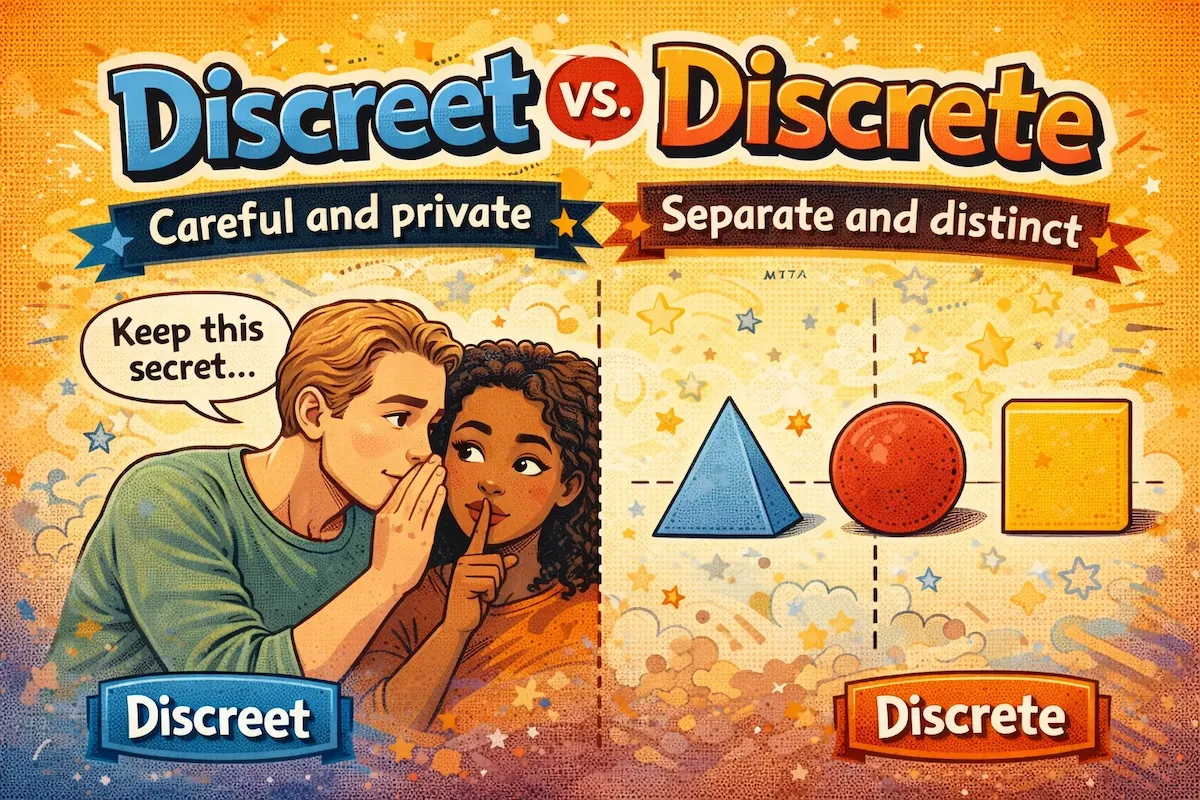
This confusing-words guide explains the difference between discreet and discrete. Learn how one relates to privacy and tact, while the other belongs to math and science, plus an easy “double E” memory trick to choose the correct spelling every time.
Some English word pairs are confusing because they look similar. Others are confusing because they sound the same. The pair discreet and discrete is especially tricky because it does both.
At first glance, these two words seem almost identical. They differ by just one letter, they sound the same when spoken, and yet their meanings live in entirely different worlds. One is about privacy and careful behavior. The other belongs to mathematics, science, and classification.
In this usage guide, you’ll learn the clear difference between discreet and discrete, how native speakers use them, and how to avoid one of the most common spelling mistakes in English. By the end, the confusion should disappear completely.
Why Discreet vs. Discrete Is So Confusing
There are three main reasons these words trip people up:
- They are pronounced the same
- They are spelled almost the same
- They appear in very different contexts
When you hear the word, context is your only clue. When you write it, spelling suddenly becomes critical.
What Does “Discreet” Mean?
Discreet describes behavior that is careful, private, or intentionally not obvious.
It is commonly associated with:
- Privacy
- Secrecy
- Tact
- Social awareness
Please be discreet about this information.
Here, the speaker wants confidentiality and sensitivity.
Discreet in Everyday Situations
You’ll often see discreet used in social and professional contexts.
She asked a discreet question during the meeting. The staff handled the situation discreetly.
The word suggests awareness of social boundaries.
Discreet and Politeness
Being discreet is often considered a positive trait.
It implies:
- Emotional intelligence
- Respect for others
- Good judgment
This is why discreet appears frequently in workplace and relationship contexts.
What Does “Discrete” Mean?
Discrete means separate, distinct, or individually identifiable.
Unlike discreet, this word has nothing to do with privacy.
It is commonly used in:
- Mathematics
- Science
- Statistics
- Technical writing
The data is divided into discrete categories.
Discrete as “Separate Units”
The key idea behind discrete is separation.
The system consists of several discrete components.
Each part exists independently.
Discrete vs Continuous
In academic contexts, discrete is often contrasted with continuous.
Age can be treated as a discrete variable in surveys.
This usage is common in statistics and data analysis.
Comparing the Two Meanings Side by Side
Discreet → careful, private, tactful Discrete → separate, distinct, individual
They overlap in spelling but not in meaning.
Common Mistake #1
Incorrect: Please keep this information discrete. Correct: Please keep this information discreet.
Information isn’t “separate” — it’s “private.”
Common Mistake #2
Incorrect: The experiment had discreet stages. Correct: The experiment had discrete stages.
Stages are separate units, not secret.
The “Double E” Memory Trick
A popular way to remember the difference:
Discreet → has double E → think “keep it secret”
If you’re talking about privacy, use the version with two E’s.
Why Context Matters More Than Sound
Because these words sound identical, native speakers rely entirely on context when listening.
Writers, however, must choose carefully — spelling changes meaning completely.
Formal vs Informal Usage
Discreet appears in both formal and informal writing.
Discrete appears mainly in formal, technical contexts.
This difference can help guide your choice.
Practice Test
Please answer the following questions. To see the correct answer, please click the arrow icon.
Which word relates to privacy and tact?
Answer: Discreet Explanation: It describes careful, private behavior.
Which word is common in mathematics?
Answer: Discrete Explanation: It refers to separate or distinct units.
Which sentence is correct: “a discreet data set” or “a discrete data set”?
Answer: A discrete data set. Explanation: Data sets are collections of separate elements.
What does the “double E” help you remember?
Answer: Discreet = secret. Explanation: The extra E connects to privacy.
Why This Pair Matters in Writing
Mixing up discreet and discrete can confuse readers or undermine credibility, especially in academic or professional writing.
Correct usage signals attention to detail.
Final Thoughts: Same Sound, Separate Worlds
Discreet and discrete may sound identical, but they live in completely different semantic spaces.
One is social. The other is technical.
Once you link “double E” with secrecy and “separate units” with science, the confusion disappears.