"Job" vs. "Occupation" vs. "Profession" – Which One Defines You?
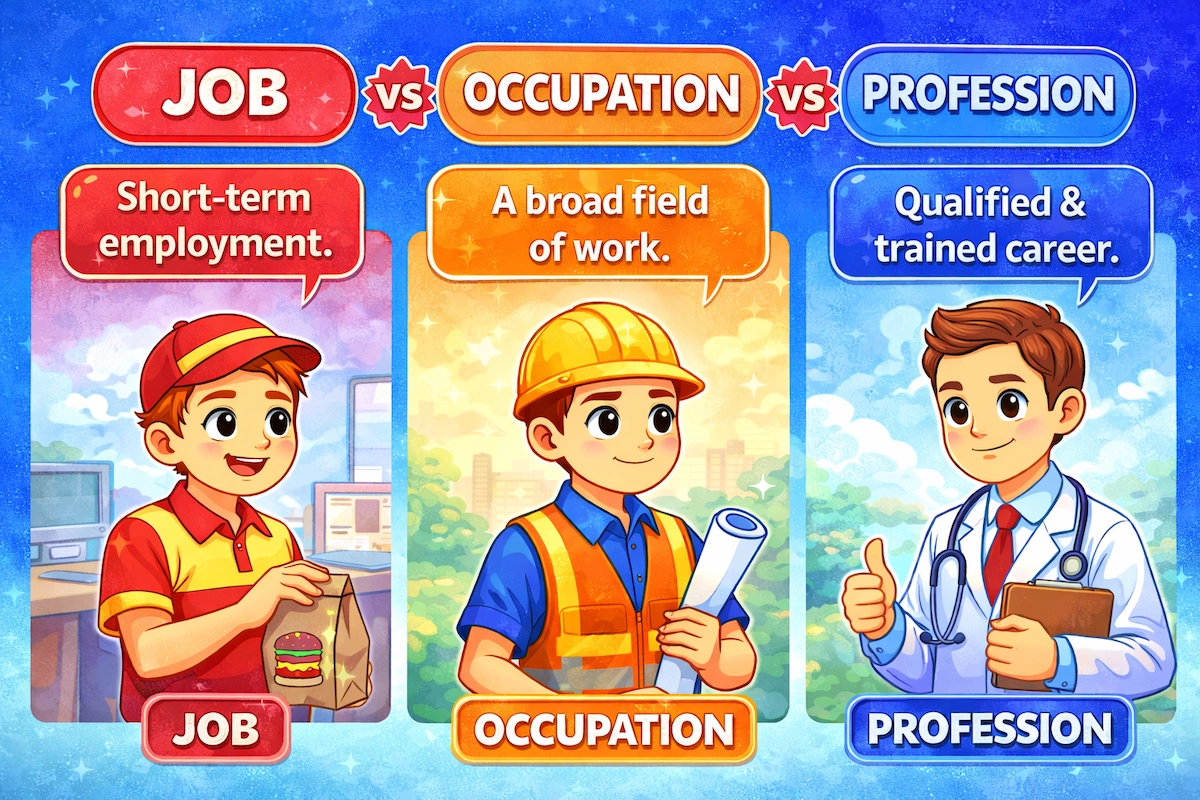
This Formal vs Informal usage guide explains how “job,” “occupation,” and “profession” differ in meaning and formality. Learn when to use each term to describe your work accurately in casual conversation, official documents, and professional profiles.
When people talk about their work in English, the word job appears everywhere. It’s simple, flexible, and easy to understand. But English actually has several words to describe what you do for a living — and each one carries a different level of formality, permanence, and social meaning.
Words like job, occupation, and profession are often treated as synonyms by learners. In reality, native speakers choose between them carefully, depending on context. Using the wrong one won’t always cause confusion — but it can make your English sound less precise or less professional than you intend.
In this usage guide, we’ll explore the real differences between job, occupation, and profession, explain how formality changes meaning, and help you describe your work accurately in casual conversation, formal writing, and professional settings.
Why Career Vocabulary Matters
Talking about work is one of the most common topics in English. It comes up in:
- Job interviews
- Networking events
- Emails and reports
- Forms and official documents
- Casual small talk
Each situation demands a different tone. Using the right word helps you sound confident, educated, and context-aware.
“Job”: The Everyday Word
Job is the most common and informal of the three terms. It refers to a specific position you do to earn money.
I just started a new job last month.
A job is usually:
- Temporary or changeable
- Specific to one employer
- Focused on tasks rather than identity
People often have many jobs throughout their lives.
Common Uses of “Job”
Native speakers use job in casual and neutral contexts:
- What’s your job?
- I’m looking for a job.
- She quit her job last year.
It’s friendly, practical, and non-technical.
Why “Job” Can Sound Too Casual
While “job” is perfectly correct, it can sound too informal in:
- Academic writing
- Official documents
- Professional profiles
- Policy or research contexts
In these situations, more formal terms are preferred.
“Occupation”: The Formal Category
Occupation is a more formal and neutral term. It refers to the general type of work a person does, not a specific position.
Please state your occupation on the form.
Occupation focuses on:
- Type of work
- Economic activity
- Social classification
It sounds official and impersonal.
Where You’ll See “Occupation” Used
The word occupation appears frequently in:
- Government forms
- Surveys and censuses
- Legal or administrative documents
- Academic studies
It’s not commonly used in casual conversation.
Why “Occupation” Sounds Distant
Because “occupation” is abstract and institutional, it doesn’t express personal identity.
My occupation is software development.
This sounds correct — but emotionally neutral.
“Profession”: Identity and Expertise
Profession is the most formal and prestigious of the three.
It usually refers to work that requires:
- Specialized education
- Formal qualifications
- Ethical standards
- Long-term commitment
Medicine is a demanding profession.
Common Professions
Traditionally, professions include:
- Doctor
- Lawyer
- Engineer
- Architect
- Teacher
These roles are often tied to identity, not just employment.
Why Not Every Job Is a Profession
While every profession is a job, not every job is a profession.
Correct: Teaching is my profession. Awkward: Waiting tables is my profession.
The second sentence isn’t insulting — it just doesn’t match typical usage.
Side-by-Side Comparison
Job → specific position Occupation → general work category Profession → career identity with expertise
Choosing the Right Word by Context
Ask yourself:
- Am I speaking casually? → job
- Am I filling out a form? → occupation
- Am I describing career identity? → profession
Formal vs Informal Scenarios
Casual: I love my job. Formal document: Current occupation: data analyst. Professional bio: Her profession is civil engineering.
Common Learner Mistake #1
Incorrect: My profession is cashier. Improved: I work as a cashier.
Common Learner Mistake #2
Incorrect (survey): What is your job? Correct: What is your occupation?
Why Native Speakers Switch Terms Naturally
Native speakers don’t think in rules — they feel the social weight of words.
Learning this distinction helps you sound more natural and adaptable.
Using “Work As” to Stay Neutral
When unsure, “work as” is a safe alternative.
I work as a project coordinator.
This avoids formality issues entirely.
Why Precision Improves Professional English
Precise vocabulary reflects clear thinking.
Using the right career term shows awareness of context, hierarchy, and tone.
Final Thoughts: One Career, Three Lenses
Job, occupation, and profession are not competing words — they describe work from different angles.
Mastering their differences allows you to present yourself accurately, confidently, and professionally in any situation.
Same work. Right word.