Who’s vs. Whose: The Simple Question That Clears the Confusion
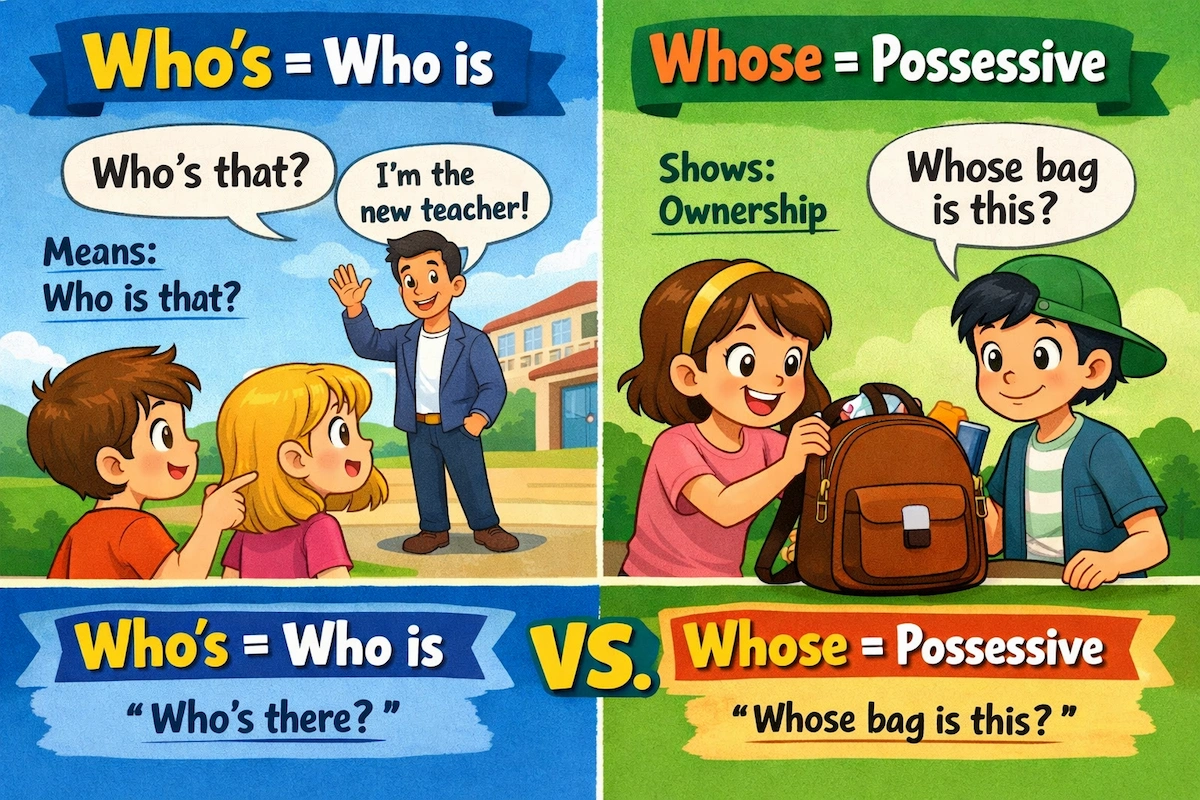
This confusing-words usage guide explains how to correctly use “who’s” and “whose.” Learn why one is a contraction and the other shows possession, how apostrophes work, and how to instantly choose the right form using a simple replacement test.
Few word pairs confuse English learners — and even native speakers — as much as who’s and whose. They look similar, sound identical, and appear in everyday writing. Yet they serve completely different grammatical purposes.
One tiny apostrophe changes everything. Use the wrong form, and your sentence can instantly look careless or confusing — especially in emails, essays, or professional communication.
In this usage guide, you’ll learn the real difference between who’s and whose, discover a simple question you can ask yourself every time, and master these two words with confidence — without memorizing complex grammar rules.
Why Who’s and Whose Are So Often Confused
This confusion happens for three main reasons:
- They are pronounced exactly the same
- They differ by only one apostrophe
- Possessive forms in English often feel inconsistent
Because the difference isn’t audible, the mistake appears most often in writing.
Understanding the Apostrophe Problem
Many learners associate apostrophes with possession. While that’s sometimes true, English also uses apostrophes for contractions — and this is where confusion begins.
In the case of who’s, the apostrophe never shows possession.
“Who’s”: A Contraction
Who’s is a contraction. It always means:
- Who is
- Who has
Who’s coming to the meeting?
This sentence expands to:
Who is coming to the meeting?
If you can replace who’s with who is or who has, then who’s is correct.
Common Uses of “Who’s”
Who’s appears frequently in:
- Questions
- Informal writing
- Spoken English
- Dialogue
Who’s been using my computer?
Here, who’s = who has.
When “Who’s” Is Impossible
If your sentence does not contain is or has, then who’s cannot be correct.
Incorrect: Who’s bag is this?
Expanded:
Who is bag is this? ❌
That sentence makes no sense — which tells us immediately that who’s is wrong.
“Whose”: Possession
Whose is a possessive pronoun. It shows ownership or association.
Whose bag is this?
This question asks about ownership — not identity.
Importantly, whose never uses an apostrophe.
Why “Whose” Has No Apostrophe
This feels strange to many learners because:
- Whose looks like it should be possessive
- Other possessives often use apostrophes
However, English possessive pronouns never use apostrophes:
- His
- Hers
- Its
- Yours
- Theirs
- Whose
This pattern is consistent — even if it feels unintuitive at first.
The One Simple Question That Solves Everything
Whenever you’re unsure, ask yourself:
Can I replace the word with “who is” or “who has”?
✔ Yes → use who’s ❌ No → use whose
This single test works almost every time.
Side-by-Side Comparison
Who’s calling you right now? Whose phone is ringing?
One asks about identity or action. The other asks about possession.
Common Learner Mistake #1
Incorrect: Whose going to present today? Correct: Who’s going to present today?
Test it:
Who is going to present today? ✔
Common Learner Mistake #2
Incorrect: Who’s responsibility is this? Correct: Whose responsibility is this?
The sentence asks about ownership, not identity.
Why Native Speakers Still Make This Mistake
Even native speakers confuse these words in writing because speech doesn’t reveal the difference.
Fast typing, autocorrect, and habit often cause the wrong choice.
This makes mastering the rule even more valuable.
Formal Writing vs Casual Writing
In informal texts or messages, mistakes sometimes go unnoticed.
In formal writing, however, confusion between who’s and whose stands out immediately.
It can affect:
- Academic credibility
- Professional image
- Reader trust
How Proofreaders Catch This Instantly
Proofreaders automatically expand contractions in their heads.
If the expanded sentence doesn’t make sense, the contraction is wrong.
You can train yourself to do the same.
Practice Exercise
Choose the correct word:
- _____ idea was approved?
- _____ coming to the conference?
Answers:
- Whose idea was approved?
- Who’s coming to the conference?
Why This Is a High-Impact Fix
This is a small correction with a big payoff.
Mastering who’s vs whose improves:
- Spelling accuracy
- Grammar confidence
- Professional credibility
And it requires remembering just one question.
Final Thoughts: Apostrophes with Purpose
Who’s and whose may sound the same, but they serve completely different grammatical roles.
One is a contraction. The other shows possession.
Ask the right question, make the right choice — and let clarity replace confusion in your English.