Stop Using "Very" for Everything – 10 Stronger Adjectives to Use Instead
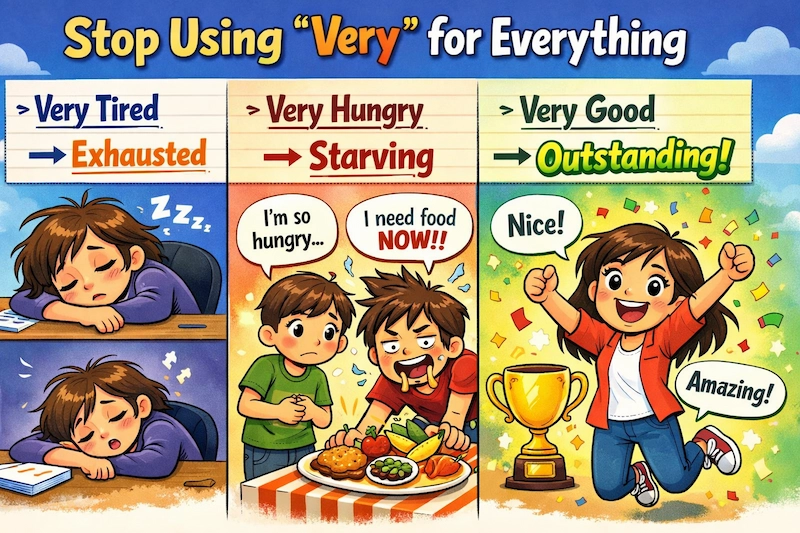
This Common Mistakes usage guide explains why relying on “very” weakens your English. Learn ten powerful adjectives that replace “very + adjective,” see clear examples, and discover how precise word choice improves fluency, confidence, and clarity in both spoken and written English.
Many English learners rely heavily on one small word: very. Very good, very tired, very interesting, very boring — the list goes on. While very is grammatically correct, using it too often is one of the most common mistakes that makes English sound flat, repetitive, and less fluent.
Native speakers do use very, but far less frequently than learners expect. Instead, they prefer stronger adjectives that already contain intensity. These words communicate emotion, precision, and confidence without needing an extra modifier.
In this usage guide, you’ll learn why overusing very weakens your English, how native speakers think about intensity, and ten powerful adjectives you can use instead to sound more natural, expressive, and fluent.
Why “Very” Is a Problem
The word very itself isn’t wrong. The problem is how often it’s used as a shortcut. When learners don’t know a stronger adjective, they add very to a basic one.
The movie was very good.
This sentence is correct — but vague. It doesn’t tell the listener how good the movie was or why it stood out.
Over time, repeated use of very makes your speech predictable and less engaging.
How Native Speakers Express Intensity
Native speakers usually express intensity by choosing a stronger adjective, not by adding an intensifier.
The movie was excellent.
One word replaces two — and sounds more confident.
This approach makes communication clearer and more efficient.
When “Very” Is Acceptable
Very is not forbidden. It works in casual conversation, especially when speaking informally or emotionally.
I’m very happy to see you.
However, in writing, presentations, interviews, and professional contexts, replacing very with precise adjectives improves tone and clarity.
1. Very Tired → Exhausted
Tired describes low energy. Exhausted shows extreme physical or mental fatigue.
Incorrect: I’m very tired after work. Better: I’m exhausted after work.
Exhausted sounds more vivid and realistic.
2. Very Hungry → Starving
Instead of intensifying hunger with very, use a word that already implies intensity.
Incorrect: I’m very hungry. Better: I’m starving.
This choice feels more natural in everyday speech.
3. Very Good → Excellent / Outstanding
Good is one of the most overused adjectives in English. Adding very rarely adds useful meaning.
Incorrect: She did a very good job. Better: She did an excellent job.
Strong alternatives include excellent, outstanding, and impressive.
4. Very Bad → Terrible / Awful
When something is truly negative, don’t soften it with basic language.
Incorrect: The service was very bad. Better: The service was terrible.
These adjectives communicate emotion more clearly.
5. Very Big → Huge / Enormous
Size is another area where English prefers strong adjectives.
Incorrect: They live in a very big house. Better: They live in a huge house.
Words like huge and enormous sound more natural and visual.
6. Very Small → Tiny / Minute
Instead of stacking words, choose one that carries meaning.
Incorrect: The details are very small. Better: The details are tiny.
This makes your sentence lighter and clearer.
7. Very Interesting → Fascinating
Interesting is often vague. Adding very doesn’t fix that.
Incorrect: The lecture was very interesting. Better: The lecture was fascinating.
Strong adjectives communicate genuine engagement.
8. Very Boring → Dull / Tedious
When something lacks excitement, use precise language.
Incorrect: The meeting was very boring. Better: The meeting was tedious.
This sounds more fluent and professional.
9. Very Beautiful → Stunning / Gorgeous
Descriptions of beauty benefit greatly from stronger vocabulary.
Incorrect: The view is very beautiful. Better: The view is stunning.
These adjectives create a clearer mental image.
10. Very Angry → Furious
Emotions are especially powerful when described accurately.
Incorrect: He was very angry about the decision. Better: He was furious about the decision.
One word communicates intensity and emotion.
Why Stronger Adjectives Improve Fluency
Using precise adjectives reduces the need for fillers and intensifiers. This makes your English sound more deliberate and controlled.
It also shows that you understand nuance — a key marker of advanced fluency.
Common Learner Mistakes
Learners often:
- Use very automatically
- Avoid stronger adjectives out of fear
- Repeat the same structures
Fluency improves when you challenge these habits.
A Simple Practice Technique
When you write or speak, pause and ask:
Is there one word that says this better than “very + adjective”?
Over time, your brain will begin choosing stronger adjectives automatically.
Final Thoughts: Say More with Fewer Words
Overusing very is a natural stage in language learning — but it’s also a habit worth breaking.
By replacing very with precise adjectives, your English becomes richer, clearer, and more confident.
Strong words create strong impressions. Choose them wisely.