"Shorten" vs. "Abbreviate" vs. "Abridge" – Making Things Smaller
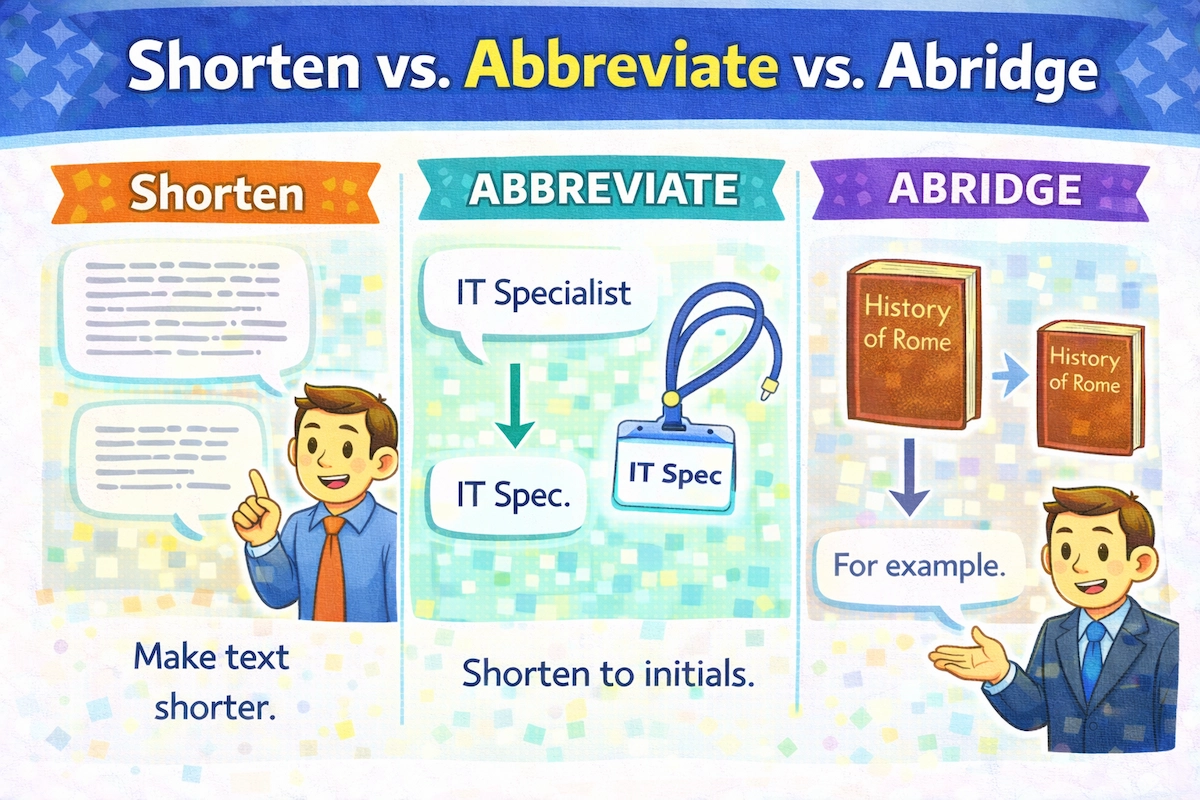
This Synonyms in Context usage guide explains the difference between “shorten,” “abbreviate,” and “abridge.” Learn which verb applies to physical length, word forms, or content reduction, see real examples, and master precise usage for clearer, more fluent English.
English has many verbs that seem to mean “make something smaller.” Words like shorten, abbreviate, and abridge are often treated as interchangeable, especially by learners. But in real usage, each of these verbs belongs to a very specific context.
Using the wrong one won’t always block understanding, but it can make your writing sound imprecise or unnatural. Native speakers instinctively choose the right verb depending on what is being reduced and how it’s being reduced.
In this usage guide, you’ll learn the exact difference between shorten, abbreviate, and abridge, see how each one works in real contexts, and understand why choosing the right word matters for clarity and fluency.
Why These Words Are Often Confused
The confusion comes from translation and overgeneralization. In many languages, one verb can cover all types of reduction. English, however, separates reduction by form, content, and function.
These three verbs answer different questions:
- Shorten → make physically or temporally shorter
- Abbreviate → reduce a word or phrase into a shorter form
- Abridge → reduce content while keeping core meaning
Let’s explore each one carefully.
What Does “Shorten” Mean?
Shorten is the most general and flexible of the three. It means to make something less long — physically, in time, or in duration.
This verb is commonly used with physical objects, time periods, and processes.
The tailor shortened the dress so it would fit properly.
We need to shorten the meeting to thirty minutes.
In both cases, the focus is on length or duration, not meaning or structure.
Common Contexts for “Shorten”
Shorten is typically used when:
- Reducing physical length (clothes, hair, cables)
- Reducing time (meetings, deadlines, processes)
- Reducing distance or range
The editor suggested shortening the introduction.
Even in writing, shorten focuses on length, not content selection.
What “Shorten” Does Not Mean
Shorten does not mean creating a special shortened form of a word, and it does not imply careful content editing.
You do not shorten a word into an acronym, and you do not shorten a novel into a version for children — those require different verbs.
What Does “Abbreviate” Mean?
Abbreviate is much more specific. It means reducing a word or phrase into a shorter written or spoken form.
This verb is almost always used with language, names, titles, or technical terms.
“Doctor” is often abbreviated as “Dr.”
The company name is commonly abbreviated in internal documents.
The meaning stays the same, but the form becomes shorter.
Common Contexts for “Abbreviate”
Abbreviate is used when:
- Creating acronyms or initialisms
- Shortening titles or names
- Using standard shortened forms in writing
The term “information technology” is often abbreviated to “IT.”
This is a technical, linguistic type of reduction.
What “Abbreviate” Does Not Mean
You do not abbreviate meetings, books, or clothing. Abbreviate is not about time, length, or content volume.
Saying “abbreviate the meeting” would sound unnatural to native speakers.
What Does “Abridge” Mean?
Abridge means to shorten a text by removing parts while keeping the main ideas. This verb focuses on content selection and preservation of meaning.
It is commonly used with books, articles, speeches, and legal texts.
The novel was abridged for younger readers.
The speech was abridged to fit the time limit.
The goal is not just to make something shorter, but to make it shorter intelligently.
Common Contexts for “Abridge”
Abridge is typically used when:
- Editing long texts
- Creating condensed versions of books
- Reducing content without losing core meaning
Because of this, abridge often sounds formal or academic.
Side-by-Side Comparison
Seeing these verbs together clarifies their roles:
- Shorten → reduce length or duration
- Abbreviate → reduce a word or phrase into a shorter form
- Abridge → reduce content while preserving meaning
The tailor shortened the dress. The editor abridged the book. The writer abbreviated the title.
Common Learner Mistakes
Learners often make these errors:
- Using shorten for words or acronyms
- Using abbreviate for meetings or time
- Using shorten instead of abridge for books
These mistakes don’t always confuse meaning, but they weaken precision.
Why Context Matters More Than Meaning
All three verbs relate to reduction, but native speakers choose based on context, not dictionary definitions.
Asking “What exactly is being reduced?” usually reveals the correct verb.
Formal vs Informal Usage
Shorten is neutral and common in everyday English.
Abbreviate is technical and common in academic or professional writing.
Abridge is formal and often appears in publishing or education.
Memory Shortcut
Use this quick mental check:
- If it has length → shorten
- If it’s a word → abbreviate
- If it has content → abridge
This shortcut works in most real situations.
Final Thoughts: Precision Creates Fluency
Shorten, abbreviate, and abridge all describe reduction, but each one does a very different job. Using them correctly shows control, clarity, and advanced fluency.
When you match the verb to the type of reduction, your English becomes more accurate — and more natural.
Precision isn’t about sounding complicated. It’s about choosing the right word for the right context.