Wait vs. Weight: Staying Behind vs. How Much You Scale
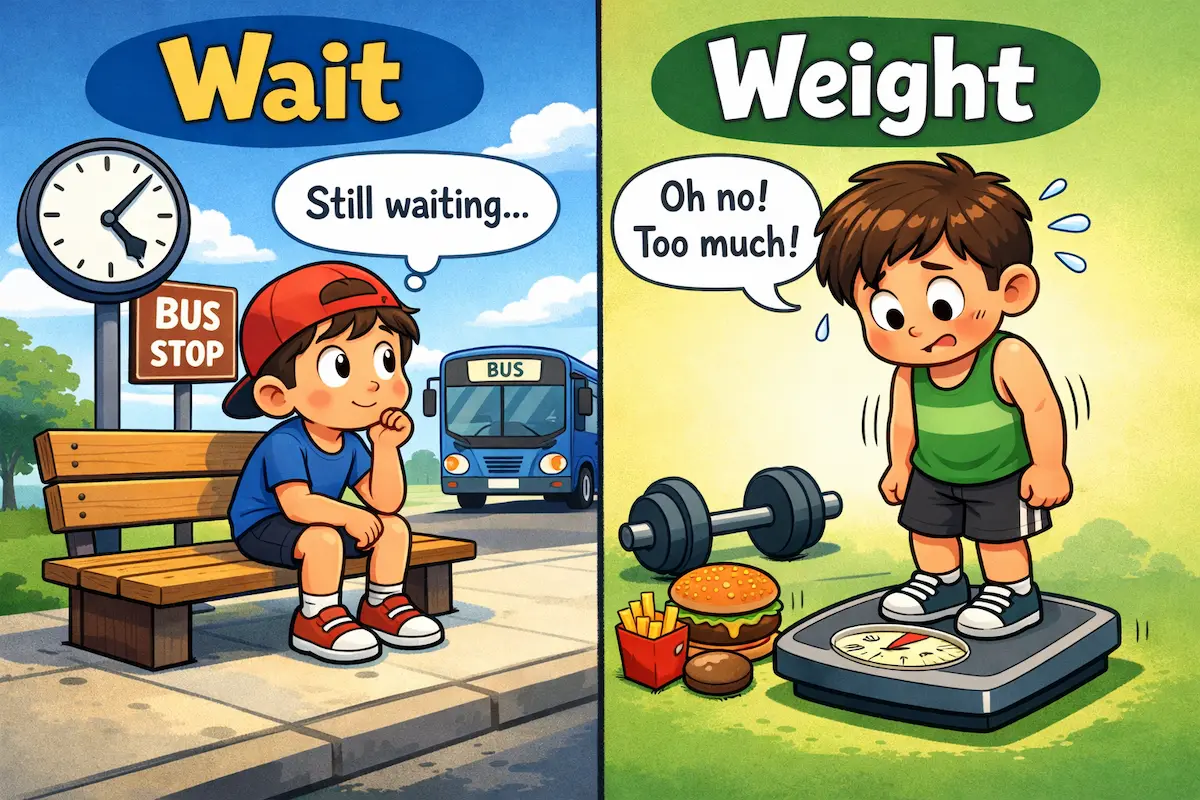
Do you wait for results or check your weight on a scale? These homophones sound the same but have completely different meanings. This guide explains the grammar, patterns, spelling tricks, and common mistakes so you never mix up patience with physical mass again.
English has many homophones — words that sound the same but have completely different meanings. One classic example that confuses learners (and even native speakers) is “wait” and “weight.”
They sound identical in pronunciation. But one is about time and patience, and the other is about mass, heaviness, and measurement.
Do you “wait” for something? Or do you measure its “weight”? Do you lose “weight”? Or are you “waiting” for results?
In this complete guide, we will break down:
- The definition of each word
- Their parts of speech
- Common sentence patterns
- Frequent spelling mistakes
- Memory tricks to avoid confusion
- A full interactive Practice Test
Part 1: What Does “Wait” Mean?
Wait is primarily a verb. It means:
- To stay in one place until something happens
- To delay action
- To remain in expectation
Please wait here. I waited for the bus. We are waiting for the results.
The key idea behind “wait” is time. You are not moving forward yet.
Common Sentence Patterns with “Wait”
1. Wait + for + noun
She waited for her friend.
2. Wait + to + verb
I can’t wait to see you.
3. Wait + until + clause
Wait until the rain stops.
Part 2: What Does “Weight” Mean?
Weight is usually a noun. It refers to:
- The heaviness of something
- How much mass something has
- A measurable physical quantity
What is your weight? The weight of the box is 5 kilograms. She lost weight after exercising.
“Weight” is about physical mass, not time.
Common Patterns with “Weight”
1. Lose weight
He is trying to lose weight.
2. Gain weight
She gained weight during the holidays.
3. The weight of + noun
The weight of the luggage exceeded the limit.
Why They’re Confusing
The confusion happens because:
- They are pronounced the same (/weɪt/)
- They differ by only two letters
- They appear in everyday contexts
Many learners accidentally write:
❌ I can’t weight any longer. ✔ I can’t wait any longer.
❌ What is your wait? ✔ What is your weight?
The Memory Trick
Here’s a simple rule:
- Wait → No extra letters → Simple action → Time
- Weight → Has “gh” → Extra letters → Extra mass
You can also remember:
Weight → “gh” looks heavy.
Deeper Grammar Insight
“Wait” as a Noun
“Wait” can also be a noun, meaning a delay.
The wait was long.
“Weight” as a Verb
“Weight” can be used as a verb in rare or technical contexts:
The survey results were weighted statistically.
Abstract Meanings of “Weight”
“Weight” can also mean importance.
Her opinion carries great weight.
This does not refer to physical mass, but influence.
Quick Comparison Table
Wait → Time, patience, delay Weight → Mass, heaviness, measurement
Practice Test
Please answer the following questions. To see the correct answer, please click the arrow icon.
1. I can’t ___ to hear the news.
Answer: wait Explanation: This refers to anticipation, which relates to time.
2. She gained ___ during the winter.
Answer: weight Explanation: This refers to physical mass.
3. The ___ of the package is 10 kg.
Answer: weight Explanation: This describes measurable heaviness.
4. Please ___ here until I return.
Answer: wait Explanation: This refers to remaining in place.
5. Her words carried great ___.
Answer: weight Explanation: This is a metaphorical meaning of importance.
6. I had to ___ for an hour at the airport.
Answer: wait Explanation: This refers to time delay.
7. He is trying to lose ___ before summer.
Answer: weight Explanation: This refers to body mass.
8. Don’t ___ too long to make a decision.
Answer: wait Explanation: This refers to delaying action.
Final Takeaway
Even though “wait” and “weight” sound identical, they live in completely different semantic worlds.
One belongs to time and patience. The other belongs to mass and measurement.
When you write, slow down and ask:
- Am I talking about time?
- Or am I talking about heaviness?
That single question will prevent 99% of mistakes.