Gilt vs. Guilt: Why One is Gold and the Other is Heavy
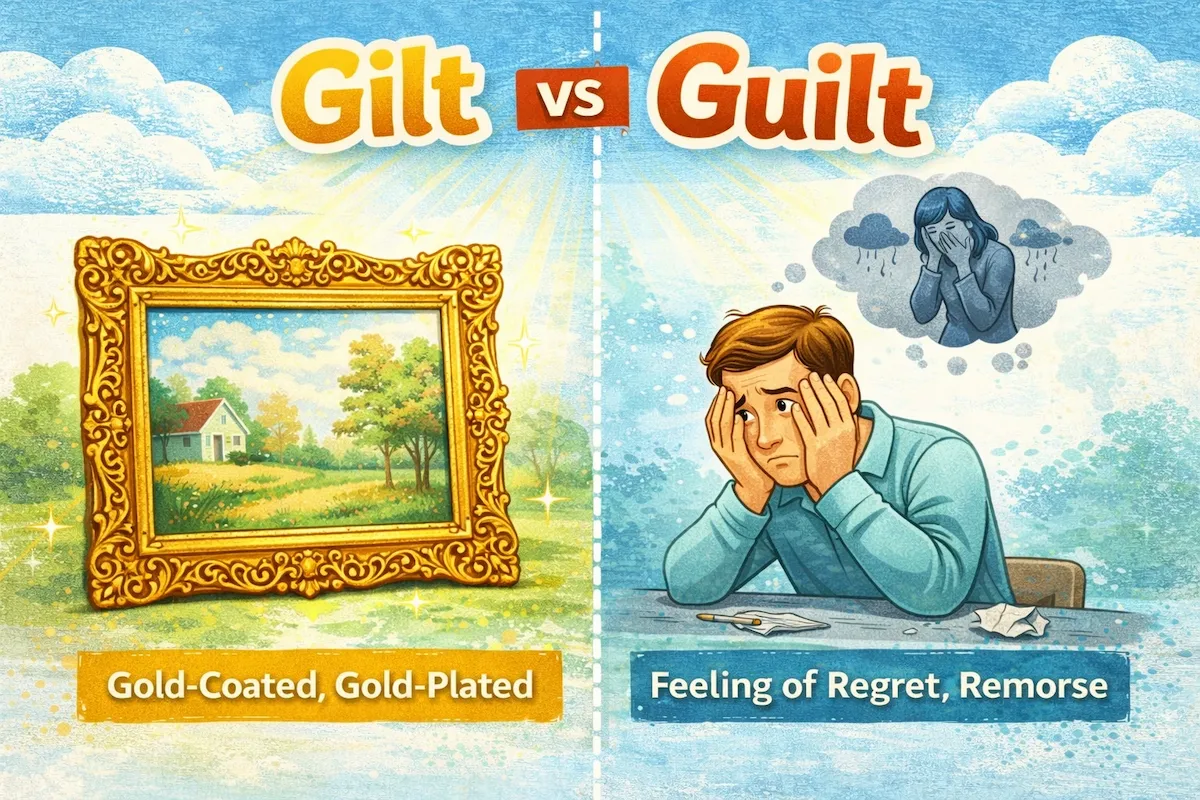
This confusing-words usage guide explains the difference between “gilt” and “guilt.” Learn how spelling changes meaning, why these homophones cause errors, and how to choose the correct word when describing gold-covered objects versus feelings of regret.
English has many confusing word pairs, but few cause as much embarrassment as gilt and guilt. They look almost identical, sound exactly the same, and yet refer to completely different ideas. One belongs to the world of gold, art, and decoration. The other belongs to emotion, morality, and responsibility.
If you’ve ever typed “I feel gilt about what I did” and hesitated before hitting send, you’re not alone. This is a classic spelling trap — and one that can subtly change the meaning of your sentence in a way native speakers notice instantly.
In this usage guide, we’ll break down the difference between gilt and guilt, explain why they’re confused so often, and show you how to choose the right one every time with confidence.
Why Gilt and Guilt Are So Easy to Confuse
The confusion comes from three main factors:
- They are pronounced the same
- They differ by only one letter
- They appear mostly in written English
Because spoken English doesn’t reveal spelling, learners often guess incorrectly when writing.
What Does “Guilt” Mean?
Guilt is a noun that refers to the feeling or state of having done something wrong.
It is closely connected to:
- Responsibility
- Regret
- Moral awareness
- Legal accountability
She felt deep guilt after lying to her friend.
Here, guilt describes an emotional burden — something heavy and internal.
How “Guilt” Is Used in Real English
Guilt often appears with emotional verbs:
- feel guilt
- carry guilt
- overcome guilt
He struggled with guilt for years after the incident.
The word rarely describes objects or appearances.
Legal and Moral Uses of “Guilt”
In legal contexts, guilt refers to responsibility for a crime.
The jury must decide whether the defendant’s guilt has been proven.
In moral discussions, it refers to conscience rather than law.
What Does “Gilt” Mean?
Gilt has a completely different meaning.
It refers to something that is:
- Covered with a thin layer of gold
- Gold-colored or gold-plated
The mirror had a beautiful gilt frame.
Here, gilt describes physical appearance — not emotion.
Gilt as an Adjective
Most commonly, gilt is used as an adjective.
a gilt statue a gilt-edged book
In these cases, it modifies a noun directly.
Gilt as a Noun (Less Common)
In some contexts, gilt can also function as a noun.
The gilt on the frame had faded over time.
This usage refers to the gold coating itself.
Why “Gilt” Never Refers to Feelings
One of the easiest ways to remember the difference:
Gold → gilt Emotion → guilt
If your sentence describes a feeling, “gilt” will always be wrong.
Common Learner Mistake #1
Incorrect: I feel gilt about what I said. Correct: I feel guilt about what I said.
The sentence describes emotion, not decoration.
Common Learner Mistake #2
Incorrect: The picture had a guilt frame. Correct: The picture had a gilt frame.
Frames don’t feel regret — people do.
Why Native Speakers Notice This Error Instantly
To native speakers, confusing these words feels jarring.
It’s similar to confusing:
- steel and steal
- brake and break
- plain and plane
The spelling instantly signals meaning.
A Simple Memory Trick
Remember:
Guilt → has a U like YOU (personal feeling) Gilt → no U, just gold
This small trick prevents big mistakes.
Practice Test
Please answer the following questions. To see the correct answer, please click the arrow icon.
Which word describes a feeling after doing something wrong?
Answer: Guilt. Explanation: Guilt refers to emotional or moral responsibility.
Which word fits: a ___ frame covered in gold?
Answer: Gilt. Explanation: Gilt describes gold-covered objects.
Why is “I feel gilt” incorrect?
Answer: Because gilt refers to appearance, not emotion. Explanation: Feelings require the word “guilt.”
Can “gilt” be a noun?
Answer: Yes. Explanation: It can refer to the gold coating itself.
Why This Difference Matters in Writing
Mixing up gilt and guilt can:
- Change meaning completely
- Reduce credibility
- Distract the reader
Correct spelling shows precision and confidence.
Final Thoughts: Gold vs Weight
These two words may sound identical, but they live in different worlds.
Gilt shines on the outside. Guilt weighs on the inside.
Once you see that contrast, you’ll never confuse them again.