"Angry At" vs. "Angry With" – Does it Really Matter?
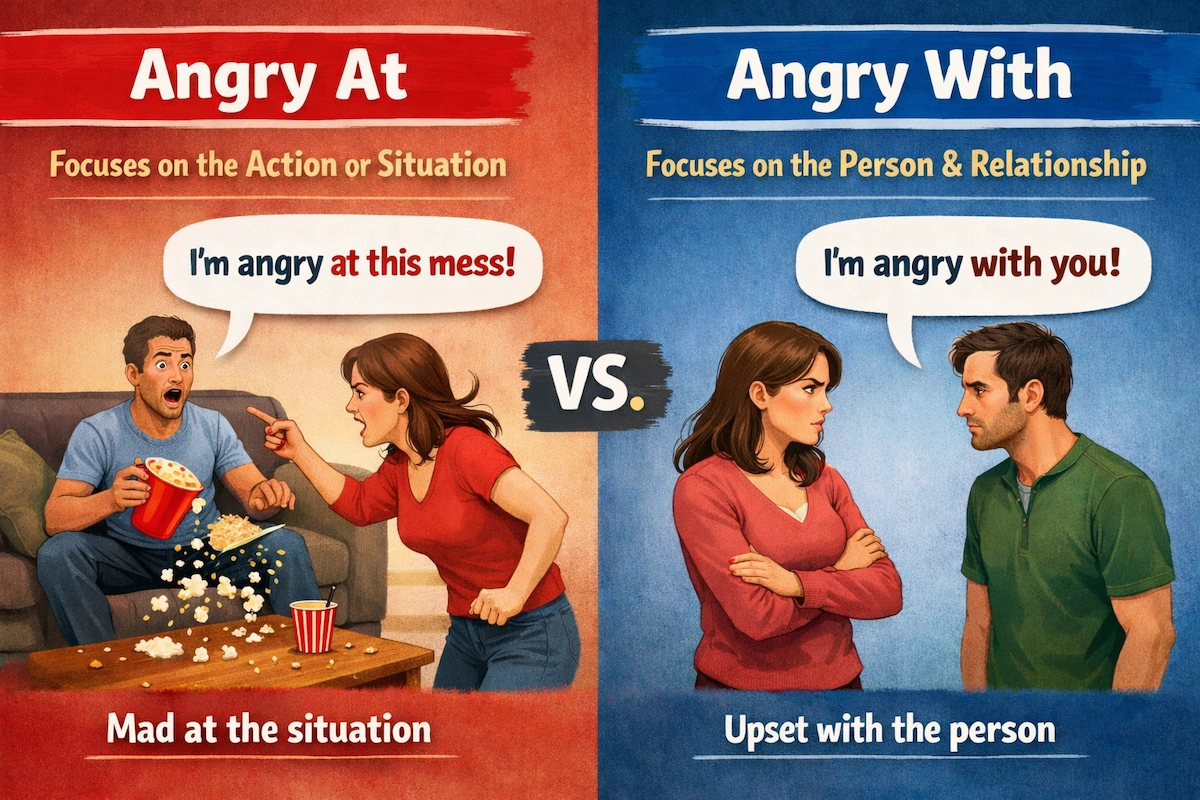
This preposition-tips usage guide explains the difference between “angry at” and “angry with.” Learn how each preposition shifts focus from actions to relationships, affects emotional tone, and helps you express anger more naturally and accurately in modern English.
English learners often ask a very reasonable question: is there really a difference between being angry at someone and being angry with someone? After all, both phrases talk about the same emotion — anger — and both appear in everyday English.
The short answer is yes, it does matter. The difference is subtle, but meaningful. Choosing between at and with changes how your anger is perceived: whether it sounds temporary or personal, situational or relational.
In this usage guide, we’ll explore how angry at and angry with work, why native speakers choose one over the other, and how these small prepositions quietly communicate blame, distance, and emotional tone.
Why Prepositions Matter More Than You Think
Prepositions in English don’t just describe location or direction. When used with emotions, they shape meaning and attitude.
Compare:
I’m angry at you. I’m angry with you.
Grammatically, both are correct. Socially, they feel different.
The Core Difference in Simple Terms
The easiest way to understand the difference is this:
- Angry at focuses on a specific action or situation
- Angry with focuses on the person and the relationship
One points outward at a cause. The other stays between people.
“Angry At”: Reaction to an Action or Event
Angry at is often used when anger is triggered by something specific that happened.
I’m angry at him for being late again.
The focus here is the behavior — not the person’s character.
Typical Uses of “Angry At”
Native speakers commonly use angry at when:
- Reacting to a mistake
- Responding to a single event
- Expressing short-term frustration
- Talking about abstract causes
She was angry at the delay. They were angry at the decision.
In these cases, there may not even be a clear person involved.
“Angry With”: Emotional Tension Between People
Angry with suggests an ongoing emotional state involving a relationship.
I’m angry with my brother.
This sounds more personal and more emotional than “angry at.”
What “With” Communicates Emotionally
The preposition with implies closeness or involvement. When paired with anger, it suggests:
- Personal disappointment
- Relational tension
- Emotional engagement
You are emotionally with the person — even while upset.
Side-by-Side Comparison
I’m angry at her for canceling. I’m angry with her.
The first sentence feels situational. The second feels deeper and more personal.
Anger That Passes vs Anger That Lingers
Another helpful way to think about it:
- Angry at often fades once the issue is addressed
- Angry with may last until the relationship is repaired
This is why apologies often respond to “angry with,” not “angry at.”
Everyday Conversation Examples
I was angry at the driver for cutting me off, but I got over it quickly.
She’s still angry with him after the argument last week.
Notice how time and emotional depth differ.
Using “Angry At” with Things and Situations
Angry at is almost always used with:
- Objects
- Systems
- Events
- Decisions
People are angry at the policy change.
“Angry with the policy” would sound unnatural here.
Why “Angry With” Sounds Softer
Interestingly, angry with can sometimes sound less aggressive than angry at.
That’s because it implies:
- Emotional honesty
- Potential reconciliation
- A continuing relationship
This is why it’s often used in close relationships.
Common Learner Mistake #1
Incorrect: I’m angry with the weather. Correct: I’m angry at the weather.
Weather is not a relationship — it’s a cause.
Common Learner Mistake #2
Incorrect: She’s angry at her sister for months. Better: She’s angry with her sister.
Long-lasting anger usually involves relationships.
American vs British Usage
Both forms are used in American and British English, but:
- British English slightly favors angry with for people
- American English uses both more flexibly
The meaning difference remains the same.
Formal vs Informal Contexts
In formal writing, emotional language is often softened.
The customer was angry with the service received.
“Angry at” can sound more blunt in reports or complaints.
How Native Speakers Choose Instinctively
Native speakers don’t think about rules — they feel the relationship.
They ask subconsciously:
Am I reacting to what happened — or to who did it?
That answer determines the preposition.
Practice Test
Choose the more natural option:
- I’m angry ___ my manager about the decision.
- I’m angry ___ my manager.
Answers:
- Angry at my manager about the decision
- Angry with my manager
Why This Subtle Difference Matters
Using the right preposition shows emotional intelligence.
It helps you:
- Sound more natural
- Avoid unintended harshness
- Express emotions accurately
In sensitive conversations, that difference matters.
Final Thoughts: Anger Has Direction
Anger in English is directional. It points somewhere — at a cause or with a person.
Choose angry at when you’re reacting to an action or situation. Choose angry with when emotions involve a relationship.
Mastering this distinction doesn’t just improve grammar — it improves how your feelings are understood.