"A Long Shot" – Talking About Risks and Low Probabilities
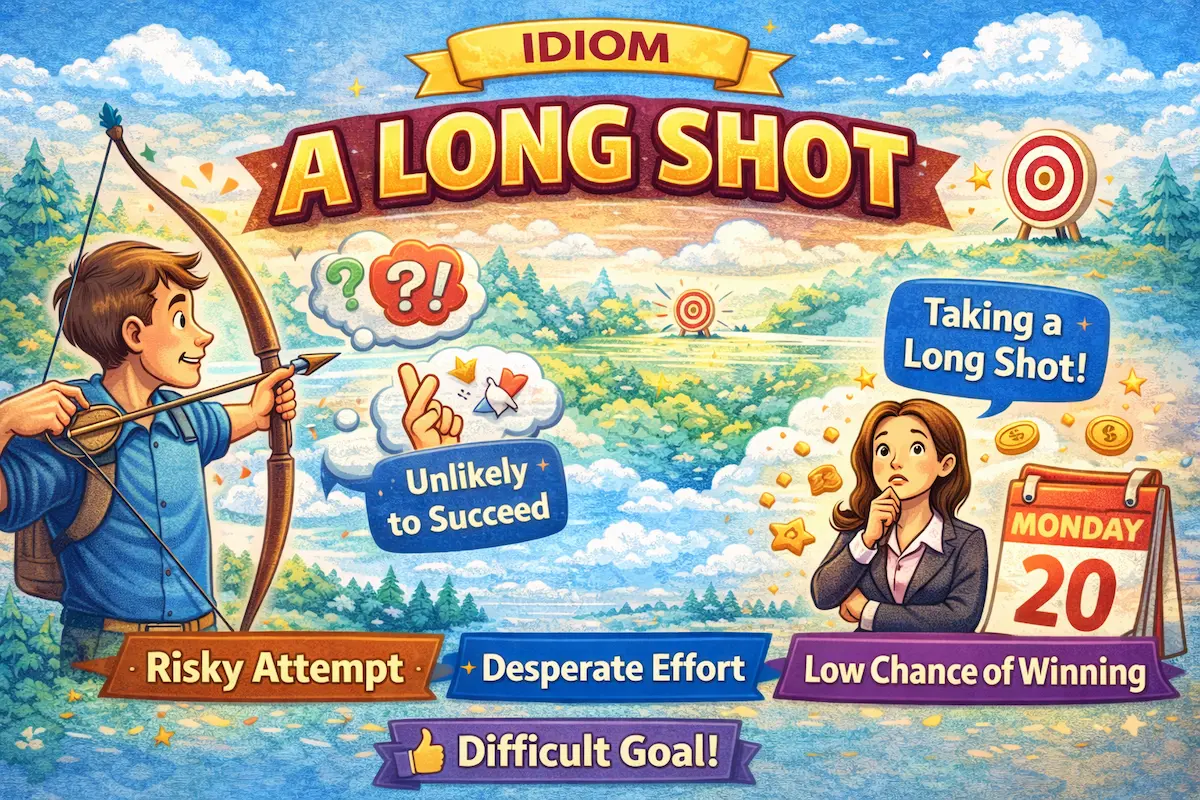
Thinking of a risky plan? “A long shot” describes something unlikely to succeed but still possible. This guide explains its origin, sentence patterns, and related idioms like “shot in the dark” and “against all odds” to help you talk naturally about risk and chance.
Have you ever had an idea that sounded exciting… but also wildly unrealistic? Maybe you wanted to apply for a dream job with almost no experience. Maybe you considered starting a business in a saturated market. Maybe you thought about confessing your feelings to someone completely out of your league.
In English, there’s a perfect idiom for that situation: “It’s a long shot.”
This expression is commonly used when describing a plan, attempt, or possibility that has a low probability of success. It doesn’t mean impossible — just unlikely.
In this complete guide, you’ll learn:
- The literal origin of “a long shot”
- Its modern meaning
- How to use it naturally in conversation
- Similar idioms about risk and chance
- Formal vs informal usage
- Professional applications
- A full interactive Practice Test
1. What Does “A Long Shot” Mean?
A long shot refers to:
- Something unlikely to succeed
- A risky attempt
- A low-probability outcome
It’s a long shot, but I’m going to apply for the scholarship anyway.
Notice the tone: cautious but hopeful.
2. The Origin of the Idiom
The phrase originally came from hunting and shooting. A “long shot” was literally a shot taken from a great distance — difficult and unlikely to hit the target.
Over time, it became metaphorical.
3. Sentence Patterns
Pattern 1: “It’s a long shot, but…”
It’s a long shot, but we might win the contract.
Pattern 2: “It was a long shot.”
Getting funding was a long shot from the beginning.
Pattern 3: “Take a long shot.”
Let’s take a long shot and try pitching to investors.
4. Tone and Context
“A long shot” is neutral to slightly informal. It can be used in:
- Casual conversation
- Business discussions
- Sports commentary
- Creative writing
5. Related Idioms About Risk
1. “A shot in the dark”
An attempt without much information.
I don’t know if he’ll respond — it’s a shot in the dark.
2. “Against all odds”
Succeeding despite very low probability.
Against all odds, the startup survived.
3. “A gamble”
A risky decision.
Investing in crypto is a gamble.
4. “Don’t hold your breath”
Don’t expect it to happen soon.
Don’t hold your breath waiting for an apology.
5. “Throw a Hail Mary”
A desperate last attempt.
The company threw a Hail Mary before bankruptcy.
6. Professional Usage
In business settings, “a long shot” can soften risky ideas.
It may be a long shot, but expanding internationally could boost growth.
It shows awareness of risk while staying optimistic.
7. Difference Between “Impossible” and “A Long Shot”
“Impossible” = zero chance. “A long shot” = low chance, but possible.
Practice Test
Please answer the following questions. To see the correct answer, please click the arrow icon.
1. If something is a long shot, is it impossible?
Answer: No. Explanation: It means unlikely, but still possible.
2. Choose the best phrase: “Winning the lottery is a ____.”
Answer: long shot Explanation: The probability is extremely low.
3. Which idiom means success despite difficulty?
Answer: Against all odds Explanation: It emphasizes overcoming unlikely conditions.
4. If you make a guess without evidence, it’s a ____.
Answer: shot in the dark Explanation: This idiom means guessing without certainty.
5. True or False: “A long shot” is formal academic language.
Answer: False. Explanation: It is conversational and semi-formal.
Final Thoughts
“A long shot” captures a very human feeling: Hope mixed with realism.
It allows you to acknowledge risk without giving up.
In conversations about careers, love, business, or dreams, this idiom helps you express bold ambition with self-awareness.
Sometimes long shots fail. But sometimes, against all odds — they succeed.