"Get me..." vs. "Could you pass me...?" – Making Requests
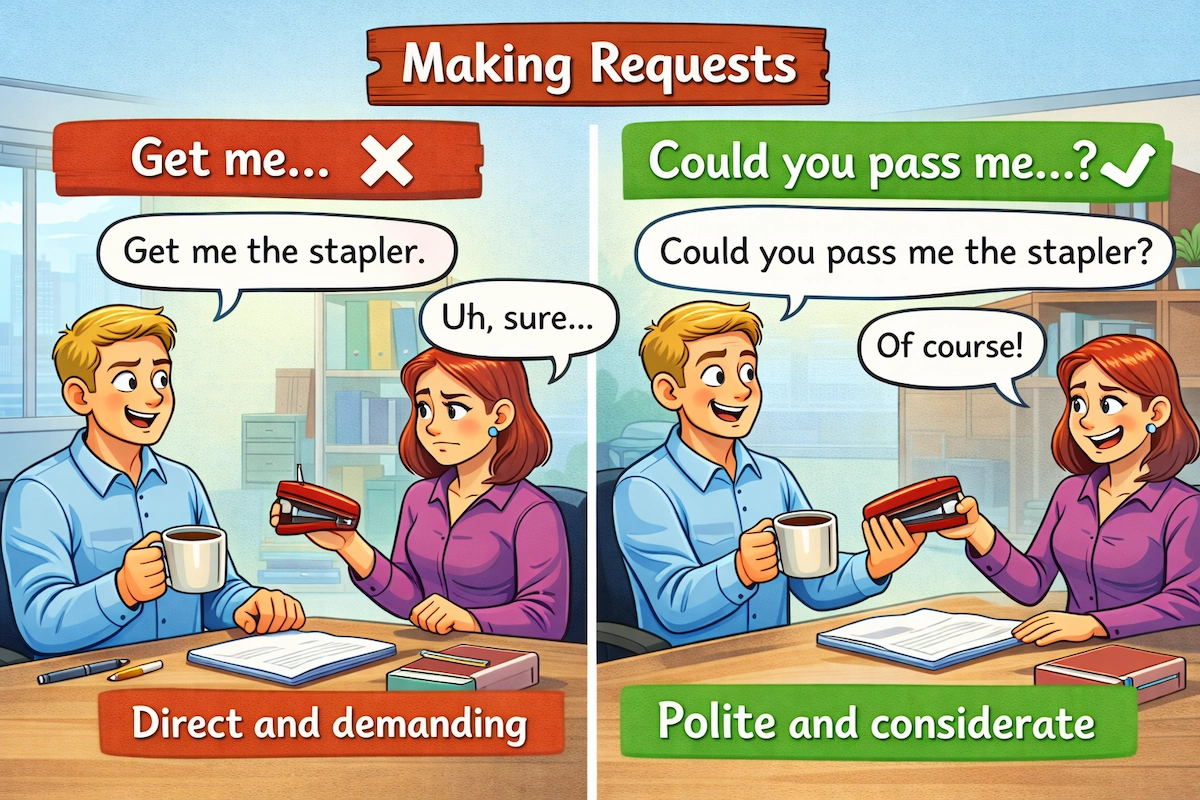
This synonyms-in-context usage guide explains the difference between “get me,” “pass me,” and “fetch” when making requests. Learn how verb choice affects politeness, effort, and social tone, and discover how to sound natural and respectful in daily and professional English.
At first glance, requests like “Get me a glass of water” and “Could you pass me the water?” seem to mean the same thing. Both ask someone to help you with something. Yet in real English, these two sentences feel very different — especially in terms of politeness, power, and social distance.
Many English learners unintentionally sound rude not because of bad grammar, but because of word choice. Verbs like get, pass, and fetch all involve bringing something — but they imply different levels of effort, authority, and relationship.
In this usage guide, we’ll explore why “get me” can sound abrupt or commanding, how “pass me” softens a request, and when “fetch” is natural — or completely inappropriate. By the end, you’ll be able to make requests that sound polite, natural, and context-aware.
Why Making Requests Is Tricky in English
Requests are not just about actions — they are about relationships.
When you ask someone to do something, you are also communicating:
- How much authority you assume
- How much effort you expect
- How close your relationship is
- How polite or urgent you want to sound
Small changes in verb choice can completely change how a request feels.
“Get Me…” – Why It Often Sounds Rude
The phrase “get me” is grammatically correct. However, in everyday English, it often sounds direct, authoritative, or even demanding.
Get me a coffee.
This sentence sounds like an order rather than a request — especially if spoken without softening words.
Native speakers often associate “get me” with:
- Hierarchical relationships
- Service roles
- Urgent commands
When “Get Me” Is Acceptable
There are situations where “get me” is natural:
- Parents speaking to children
- Bosses giving instructions (carefully)
- Very informal relationships
Can you get me my jacket?
Notice how adding “can you” already softens the tone.
Why Learners Overuse “Get”
The verb get is extremely flexible in English. It appears in dozens of meanings:
- Get a job
- Get tired
- Get home
- Get something
Because of this flexibility, learners often rely on “get” for requests — even when another verb would sound more polite.
“Pass Me…” – Polite and Context-Specific
Pass describes a very specific action: moving something from one person to another within the same space.
Could you pass me the salt?
This request sounds polite because:
- The effort required is small
- The object is nearby
- The phrasing is indirect
“Pass me” is ideal for table settings, meetings, or shared spaces.
Why “Pass Me” Sounds Softer Than “Get Me”
Compare the effort implied:
Get me the water. Pass me the water.
“Get” suggests standing up and going somewhere. “Pass” suggests a small, cooperative action.
Less effort = less imposition.
Using “Could You” to Increase Politeness
Modal verbs transform requests.
Could you pass me the document?
This structure:
- Respects choice
- Reduces pressure
- Sounds professional
“Fetch” – A Very Different Tone
Fetch means to go somewhere, retrieve something, and bring it back.
The dog fetched the ball.
Because of this association, “fetch” often sounds:
- Playful
- Old-fashioned
- Command-like when used with adults
Why “Fetch” Can Sound Insulting
Asking an adult to “fetch” something can feel demeaning.
Fetch me my bag. ❌
This sounds like you’re speaking to a pet or subordinate.
When “Fetch” Is Natural
“Fetch” works in:
- Stories or literature
- Playful language
- Talking about animals
- Light humor
He ran off to fetch help.
Here, it sounds neutral and descriptive.
Side-by-Side Comparison
Get me → direct, potentially rude Pass me → polite, cooperative Fetch → specific, often playful or commanding
How Native Speakers Choose the Right Verb
Native speakers subconsciously evaluate:
- Distance of the object
- Relationship between speakers
- Effort required
- Setting (home, office, restaurant)
The verb choice reflects all of this.
Common Learner Mistake #1
Incorrect: Get me the pen, please. Better: Could you pass me the pen?
Common Learner Mistake #2
Incorrect (formal): Get me the report. Better: Could you send me the report?
Sometimes the best solution is choosing a different verb entirely.
Why Politeness Is About Verb Choice
English politeness often avoids commands.
Instead, it uses:
- Modal verbs
- Indirect structures
- Low-imposition actions
“Pass” naturally fits this pattern better than “get.”
Professional Contexts: Avoid “Get Me”
In offices and workplaces, “get me” can sound abrupt.
Instead of: Get me the file. Use: Could you send me the file when you have a moment?
This preserves respect and professionalism.
Practice Tip
The next time you make a request, pause and ask:
Is this a command — or an invitation to help?
Adjust the verb accordingly.
Final Thoughts: One Action, Many Meanings
Get, pass, and fetch all involve bringing something — but they send very different social signals.
Mastering these differences helps you sound polite without being indirect, confident without being rude, and natural in every situation.
In English, how you ask matters just as much as what you ask for.