Emigrate vs. Immigrate: Are You Leaving or Arriving?
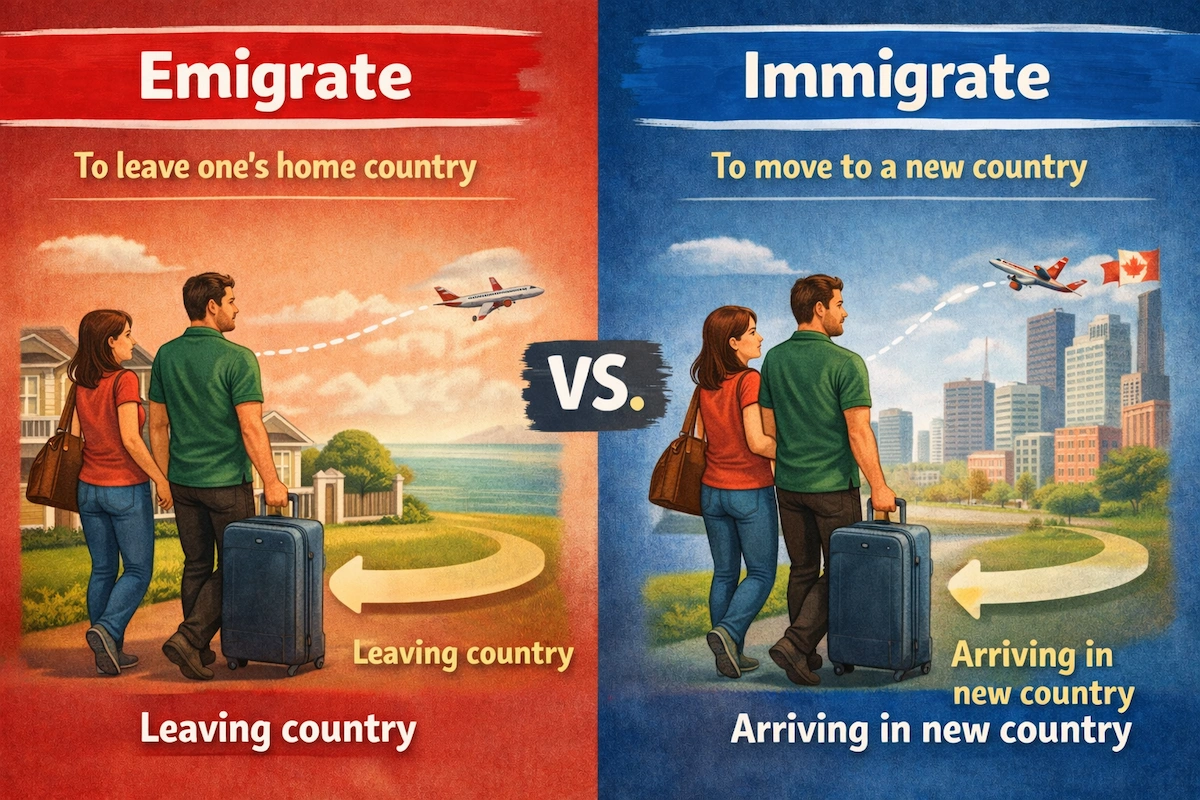
This confusing-words usage guide explains the difference between “emigrate” and “immigrate.” Learn how direction determines meaning, why “E” is for exit and “I” is for in, and how to choose the correct verb confidently in formal, legal, and everyday English.
Few verb pairs confuse English learners as consistently as emigrate and immigrate. They look similar, sound similar, and often appear in the same conversations about moving to another country. Yet they describe opposite directions.
Are you leaving a country — or arriving in one? That single difference determines whether you should use emigrate or immigrate. Many mistakes happen because speakers focus on the person moving, instead of the direction of movement.
In this usage guide, you’ll learn the clear difference between emigrate and immigrate, a simple memory trick that actually works, and how to use each verb naturally in real English — without hesitation.
Why Emigrate and Immigrate Are So Often Confused
This confusion happens for a few predictable reasons:
- The words share the same root
- They describe the same person
- The action happens at the same time
- English focuses on perspective, not the traveler
One journey can involve both verbs — just from different viewpoints.
The Core Difference in One Sentence
Here is the simplest rule:
Emigrate = leave a country Immigrate = enter a country
The action is the same. The direction is different.
“Emigrate”: To Leave a Country
Emigrate means to leave your home country to live permanently somewhere else.
Her grandparents emigrated from Italy in the 1950s.
The focus is on the country being left behind.
Typical Contexts for “Emigrate”
Native speakers use emigrate when talking about:
- Origins and background
- Family history
- Historical movements
- Reasons for leaving
Many people emigrated due to economic hardship.
“Immigrate”: To Arrive in a New Country
Immigrate means to come to a new country to live permanently.
She immigrated to Canada and started a new life.
The focus is on the destination country.
Typical Contexts for “Immigrate”
Immigrate is commonly used in:
- Legal discussions
- Government policy
- Residency status
- Citizenship processes
He immigrated legally after receiving a work visa.
One Person, Two Verbs
The same person can both emigrate and immigrate.
She emigrated from Brazil and immigrated to Portugal.
The verbs depend entirely on perspective.
The Memory Trick That Actually Works
Use this simple association:
E = Exit → Emigrate I = In → Immigrate
If you remember direction, you remember the word.
Why “Move” Is Not Always Enough
Many learners replace both verbs with move.
He moved to Germany.
While correct, this avoids important nuance:
- Legal permanence
- Nationality change
- Social context
Emigrate and immigrate add precision.
Common Learner Mistake #1
Incorrect: She immigrated from Mexico. Correct: She emigrated from Mexico.
“From” points backward — toward the country being left.
Common Learner Mistake #2
Incorrect: He emigrated to Australia. Correct: He immigrated to Australia.
“To” points forward — toward the destination.
Prepositions Help You Choose
Watch the preposition:
- Emigrate from a country
- Immigrate to a country
The preposition often reveals the correct verb.
Formal vs Informal Usage
These verbs are more formal than everyday speech.
In casual conversation, people often say:
I moved here five years ago.
In formal writing, however, emigrate and immigrate are preferred.
Business and Legal English
In contracts, reports, and policies, precision matters.
Employees who immigrate for work must obtain proper authorization.
Using the wrong verb here can cause confusion.
Practice Test
Choose the correct verb.
She decided to _____ from her home country due to political instability.
Answer: Emigrate — the sentence focuses on leaving the country.
Millions of people _____ to the United States in the early 20th century.
Answer: Immigrated — the focus is on arriving in the U.S.
His family _____ from Ireland and later settled in New York.
Answer: Emigrated — Ireland is the country being left.
She _____ to Japan after receiving permanent residency.
Answer: Immigrated — Japan is the destination.
Why This Distinction Matters
Confusing these verbs can:
- Change the meaning of your sentence
- Sound imprecise in formal writing
- Create misunderstanding in legal contexts
Fixing this mistake improves clarity instantly.
Final Thoughts: Direction Is Everything
Emigrate and immigrate describe the same journey — but from opposite directions.
Remember: E is for exit, I is for in.
Once you think in terms of direction, this confusing pair becomes one of the easiest distinctions in English.