"Forth" vs. "Fourth" – Moving Forward vs. Numerical Order
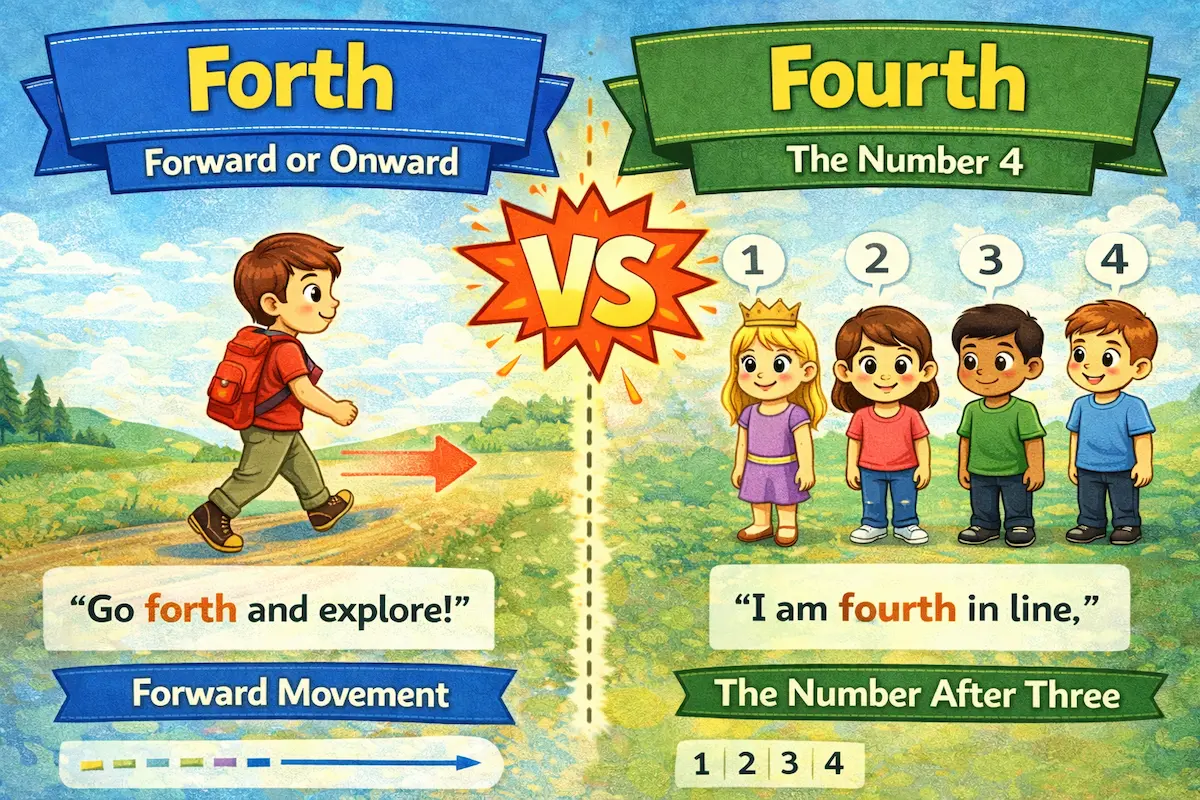
Don’t “go fourth” into the world! Forth relates to forward movement, while fourth refers to numerical position. This guide explains grammar roles, common mistakes, memory tricks, and idiomatic usage so you never confuse these two homophones again.
English has many homophones — words that sound the same but are spelled differently and carry completely different meanings. One classic example is “forth” and “fourth.”
They are pronounced exactly the same. Yet one refers to movement forward, and the other refers to numerical order.
Writing “go fourth” instead of “go forth” is a surprisingly common mistake. It looks small, but in professional writing, spelling precision matters.
In this complete guide, we will explore:
- The definition of “forth”
- The definition of “fourth”
- Sentence patterns and grammar roles
- Common spelling traps
- Memory tricks
- Formal vs informal usage
- An interactive Practice Test
1. What Does “Forth” Mean?
Forth is an adverb. It means:
- Forward in time or place
- Outward from a starting point
- Into visibility or existence
Go forth and succeed. The hero stepped forth from the shadows. New ideas came forth during the meeting.
“Forth” always relates to movement or progression.
2. What Does “Fourth” Mean?
Fourth is an ordinal number. It refers to position in a sequence.
She finished fourth in the race. Today is the fourth of July. This is the fourth chapter.
“Fourth” always connects to counting or order.
3. Key Grammar Differences
Forth → Adverb
Bring forth your ideas.
Fourth → Adjective or Noun
He was the fourth person in line. She came in fourth.
4. Common Mistakes
❌ Go fourth into the world. ✔ Go forth into the world.
❌ The ideas came fourth during the debate. ✔ The ideas came forth during the debate.
5. Memory Tricks
Here’s an easy way to remember:
- Fourth contains “four” → It relates to numbers.
- Forth does not contain a number → It relates to movement.
6. Idioms with “Forth”
Bring Forth
The policy brought forth new challenges.
Set Forth
The explorers set forth at dawn.
Go Forth
The graduates were told to go forth and make a difference.
7. Formal vs Informal Usage
“Forth” often sounds literary or formal.
The evidence set forth in the report was compelling.
“Fourth” is neutral and used in everyday speech.
Practice Test
Please answer the following questions. To see the correct answer, please click the arrow icon.
1. “The knight stepped ___ bravely.”
Answer: forth Explanation: This describes movement forward.
2. “She finished ___ in the competition.”
Answer: fourth Explanation: This refers to numerical position.
3. Which word refers to order in a sequence?
Answer: fourth Explanation: “Fourth” is an ordinal number.
4. Which sentence is correct?
Answer: Go forth and succeed. Explanation: “Forth” expresses movement forward.
5. “The ideas came ___ during the meeting.”
Answer: forth Explanation: This refers to emergence.
6. “Today is the ___ of May.”
Answer: fourth Explanation: This refers to calendar order.
Final Takeaway
Even though “forth” and “fourth” sound identical, they belong to completely different grammar categories.
- Forth → movement forward
- Fourth → numerical position
If you remember that “fourth” contains the number “four,” you’ll never mix them up again.
Small spelling differences can change meaning dramatically. Precision is power in English writing.