"Farther" vs. "Further" – Measuring Distance and Ideas
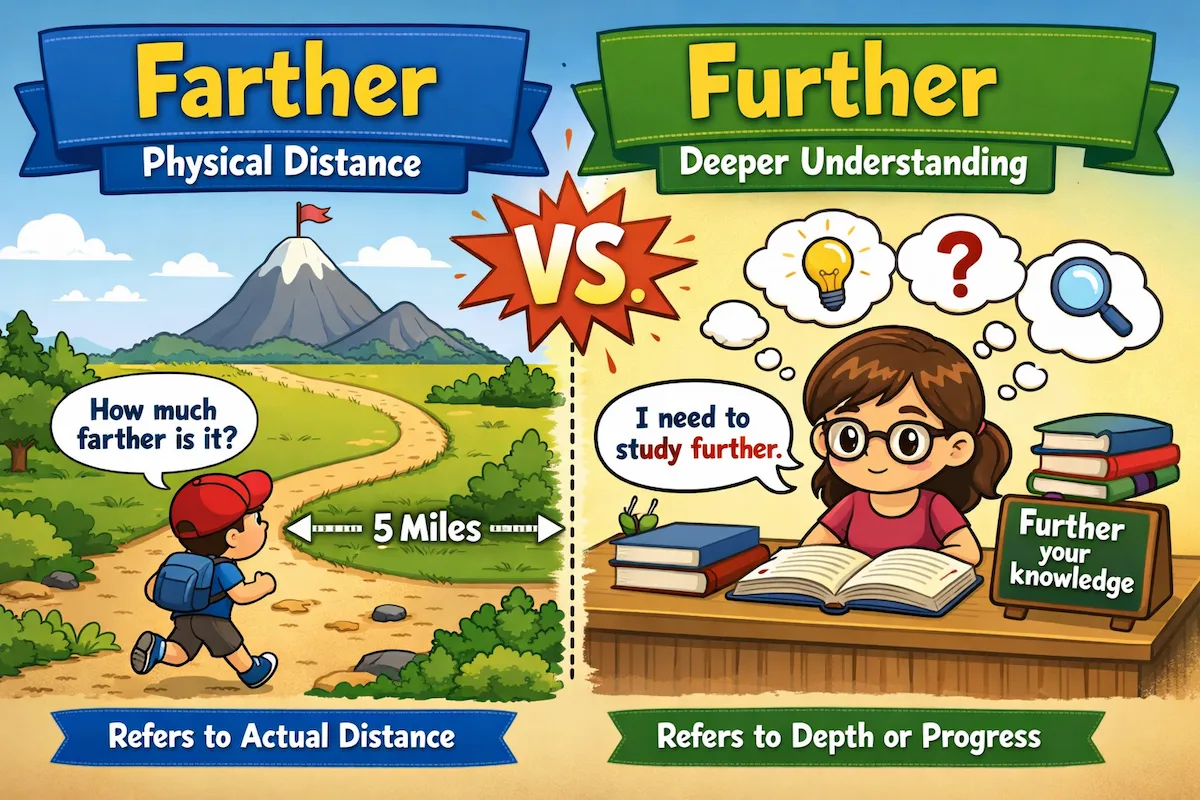
This guide explains the difference between “farther” and “further” in English. Learn when to use farther for physical distance and further for abstract ideas, additional information, and continued discussion, with examples and practice questions.
Few word pairs confuse English learners — and even native speakers — as often as “farther” and “further.” They look similar, sound similar, and are sometimes used interchangeably. Yet in careful, polished English, they serve different purposes.
The difference isn’t about spelling preference or regional style. It’s about what kind of distance you are describing: physical distance you can measure, or abstract distance involving ideas, progress, or information.
In this Common Mistakes guide, you’ll learn the clear rule that separates farther from further, see real-world examples, understand modern usage trends, and practice choosing the correct word with confidence.
The Core Difference in One Sentence
If you remember only one rule, remember this:
- Farther → physical, measurable distance
- Further → figurative, abstract, or additional distance
This simple distinction solves most confusion instantly.
What Does “Farther” Mean?
Farther is used when talking about literal distance — space you can walk, drive, measure, or see on a map.
The hotel is farther from the airport than we expected.
In this sentence, the distance exists in the physical world. You could measure it in kilometers or miles.
Common Contexts for “Farther”
- Travel and directions
- Sports and physical performance
- Geography and maps
- Movement through space
She can throw the ball farther than anyone else on the team.
Again, the distance is concrete and observable.
What Does “Further” Mean?
Further refers to distance that is not physical. It’s used for:
- Ideas
- Time
- Progress
- Discussion
- Additional information
We need to discuss this further before making a decision.
You can’t measure “discussion” in meters — that’s why further is correct.
“Further” as “More” or “Additional”
One very common use of further is to mean more.
Please contact me if you need further assistance.
Replacing “further” with “farther” here would sound wrong to most native speakers.
Side-by-Side Comparison
The village is farther down the road. Let’s look into this further.
The first sentence describes physical space. The second describes intellectual effort.
Why People Mix Them Up
There are three main reasons:
- They sound similar
- Some speakers use “further” for everything
- Casual English often ignores the distinction
In informal conversation, mixing them rarely causes misunderstanding. In writing, however, precision matters.
Is the Rule Still Relevant in Modern English?
Yes — especially in:
- Professional writing
- Academic English
- Formal reports
- Careful editing
Many style guides still recommend maintaining the distinction.
Can “Further” Ever Mean Physical Distance?
Historically, yes. You may see sentences like:
We walked further into the forest.
This is grammatically acceptable, but in modern usage, farther is usually preferred when the distance is clearly physical.
A Helpful Memory Trick
Notice the word far inside farther.
If you can replace the word with “far,” choose farther.
How far is it? → How much farther?
If “far” doesn’t fit, use further.
Business and Academic Usage
In professional contexts, further is extremely common.
Further research is required. Further action will be taken.
These phrases describe continuation, not distance.
Spoken English vs. Written English
In spoken English, many native speakers default to further.
In written English, especially edited writing, farther still signals clarity and care.
Common Errors to Avoid
- ❌ Further down the street (when emphasizing distance)
- ❌ Farther information is needed
Correct versions:
Farther down the street. Further information is needed.
Practice Test
Please answer the following questions. To see the correct answer, please click the arrow icon.
Which word should you use for physical distance?
Answer: Farther. Explanation: It refers to measurable space.
“We need to investigate this ___.” Which word fits?
Answer: Further. Explanation: The distance is abstract.
Is “further research” correct?
Answer: Yes. Explanation: It refers to additional work, not space.
Which sentence is correct?
Answer: The store is farther away. Explanation: The distance is physical.
Do people always follow this rule in conversation?
Answer: No. Explanation: Casual speech often ignores the distinction.
Final Thoughts: Distance Matters
“Farther” and “further” may feel interchangeable, but understanding their difference helps your English sound more precise and professional.
Use farther when you can measure the distance. Use further when you’re moving through ideas, time, or conversation.
Mastering this small distinction is a big step toward polished, confident English.