"Married To" vs. "Married With" – Avoiding a Common Social Mistake
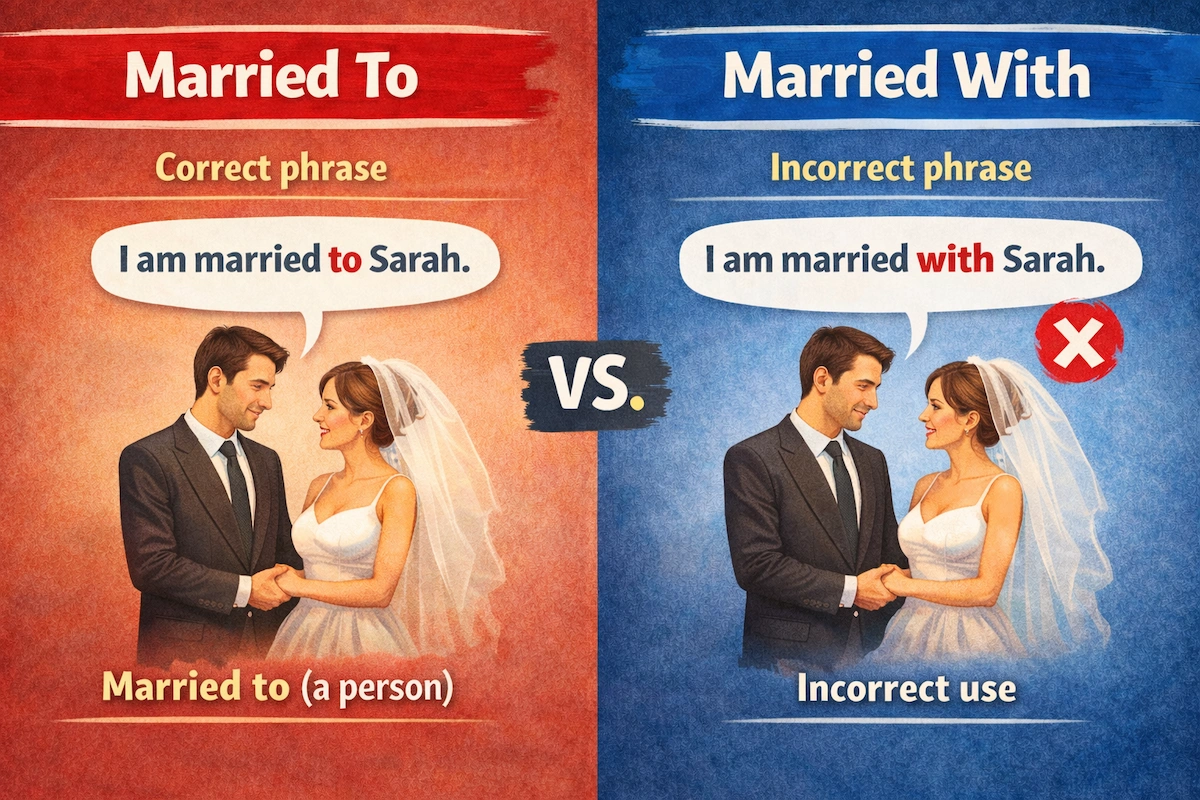
This preposition-tips usage guide explains the difference between “married to” and “married with.” Learn why “married to” is the only correct choice for a spouse, how “with” changes meaning, and how to avoid a common social mistake in English.
Few English mistakes are as small — yet as socially awkward — as confusing married to and married with. At first glance, the difference seems trivial. After all, both phrases include the word “married,” and both talk about relationships.
But in real English, choosing the wrong preposition can accidentally change the meaning of your sentence — or make it sound unnatural, confusing, or even humorous. Saying “married with someone” when you mean a spouse is one of the most common preposition mistakes learners make.
In this usage guide, we’ll explain why married to is always correct when referring to a spouse, what married with actually means, and how this small preposition choice affects clarity, tone, and social meaning in English.
Why This Mistake Happens So Often
Learners confuse married to and married with for a few common reasons:
- Many languages use one preposition for marriage
- “With” feels natural when talking about people
- The mistake still sounds understandable
- Grammar rules for prepositions feel inconsistent
Unfortunately, “understandable” does not mean “correct” — especially in social situations.
The Core Rule (Remember This)
Here is the rule you should memorize:
You are married to a person. You are never married with a person.
This rule has no exceptions when talking about spouses.
“Married To”: The Only Correct Choice for a Spouse
Married to is the fixed and standard preposition used to describe a marital relationship between two people.
She is married to a doctor.
This structure is used in:
- Everyday conversation
- Formal writing
- Legal documents
- Biographies
Native speakers never question this usage.
Why “To” Is Used Here
The preposition to often expresses connection, direction, or relationship.
In marriage, “to” signals a direct relational link between two individuals.
He is married to his high school sweetheart.
The relationship is clearly defined and exclusive.
“Married With”: What It Actually Means
While married with is wrong when referring to a spouse, it is not always grammatically incorrect.
Married with is used to describe something that accompanies marriage — not the spouse.
She is married with two children.
Here, “with” introduces an additional condition, not the partner.
Understanding the Role of “With”
The preposition with usually means:
- Accompanied by
- Including
- Together with something extra
That’s why it works for children, responsibilities, or conditions — but not for a spouse.
Side-by-Side Comparison
She is married to John. She is married with two children.
One identifies the partner. The other adds information.
Why “Married With Someone” Sounds Wrong
Saying “married with someone” sounds unnatural because:
- It treats the spouse like an accessory
- It breaks the fixed collocation
- Native speakers never use it
Even though the meaning may be guessed, the sentence feels off.
Common Learner Mistake #1
Incorrect: She is married with a lawyer. Correct: She is married to a lawyer.
Common Learner Mistake #2
Incorrect: I am married with my husband for ten years. Correct: I have been married to my husband for ten years.
Notice how verb tense and preposition both matter.
Formal vs Informal English
In both formal and informal English, the rule stays the same.
The applicant is married to a permanent resident.
Legal and official documents rely on this fixed structure.
Why This Matters Socially
Talking about marriage is personal. Using the wrong preposition can:
- Sound careless
- Cause confusion
- Distract from your message
Correct usage shows respect and fluency.
Practice Test
Please answer the following questions. To see the correct answer, please click the arrow icon.
She has been married ___ her partner for over a decade.
Answer: to Explanation: We always use “married to” when referring to a spouse.
He is married ___ three children and works full time.
Answer: with Explanation: “With” introduces accompanying information, not the spouse.
The actress is married ___ a well-known director.
Answer: to Explanation: The sentence identifies the spouse.
She is married ___ one child and two dogs.
Answer: with Explanation: “With” lists accompanying responsibilities or conditions.
A Simple Final Check
Before you choose the preposition, ask:
Am I naming the spouse — or adding extra information?
Spouse → to Extra information → with
Final Thoughts: One Preposition, One Meaning
Marriage in English always connects two people with to.
Married with has its place — just not where most learners try to use it.
Mastering this small distinction helps you sound natural, confident, and socially accurate in English.