Prepositions with "Care": Care "About" vs. Care "For"
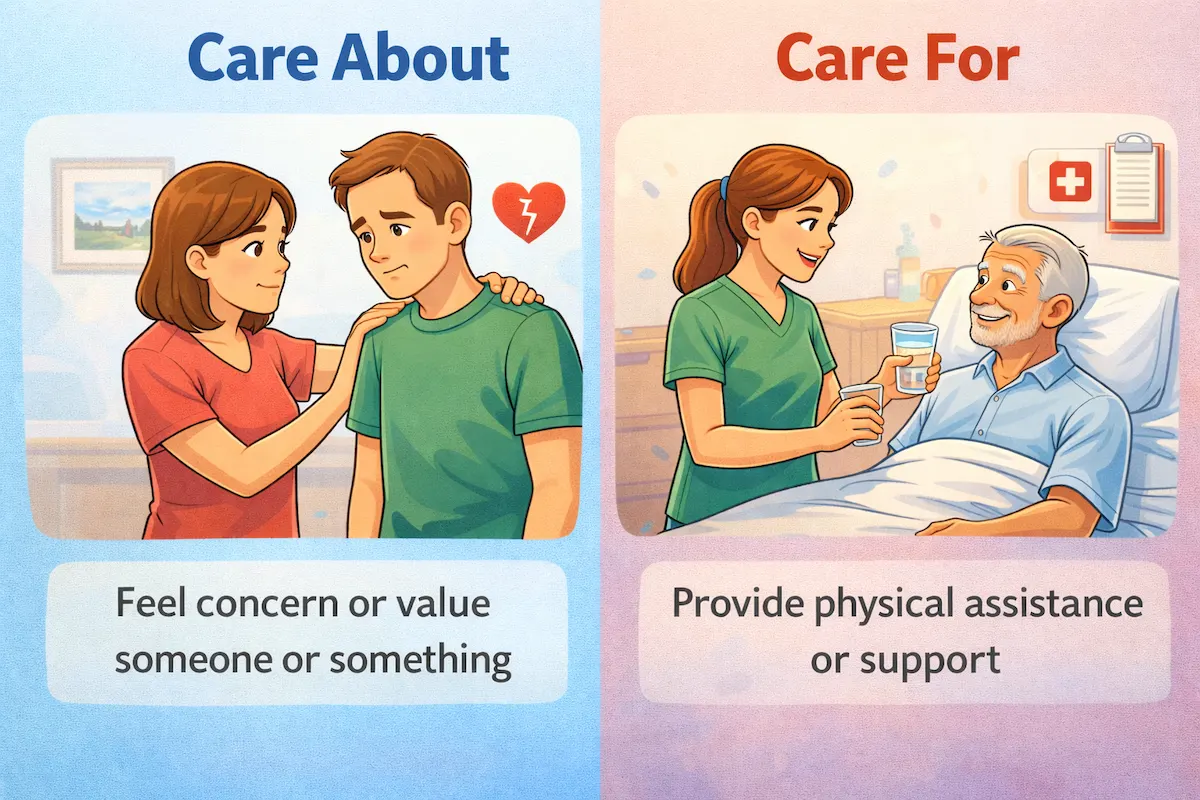
This preposition tips guide explains the difference between care about and care for. Learn when to express emotional concern, when to describe real responsibility, and how choosing the wrong preposition can change your meaning in daily and professional English.
Few English verbs become confusing not because of their meaning, but because of the prepositions that follow them. One of the most common examples is the verb care, which changes meaning dramatically depending on whether it is followed by about or for.
At first glance, care about and care for seem interchangeable. Both involve concern, emotion, or attention. But in real English usage, they describe two very different types of relationships — one emotional, the other practical.
In this preposition tips guide, you’ll learn exactly how care about and care for differ, how native speakers interpret them, and how to choose the right one without hesitation in daily, professional, and emotional contexts.
Why Prepositions Change Meaning So Much
In English, verbs often gain new meanings when paired with prepositions. These combinations are not logical formulas — they are usage-based patterns.
With care, the preposition tells us what kind of care we are talking about:
- Emotional concern → care about
- Physical or practical responsibility → care for
Mixing them up can completely change your message.
What Does “Care About” Mean?
Care about means to feel emotional concern, interest, or importance.
I care about my friends.
This sentence expresses emotional attachment, not physical responsibility.
Key Uses of “Care About”
You use care about when talking about:
- Feelings
- Values
- Opinions
- Personal importance
She really cares about her career.
Care About Is Emotional, Not Active
Caring about something does not require action.
He cares about the environment.
This does not automatically mean he takes care of environmental projects.
What Does “Care For” Mean?
Care for means to look after, support, or take responsibility for someone or something.
She cares for her elderly parents.
This implies daily actions, effort, and responsibility.
Key Uses of “Care For”
You use care for when talking about:
- Children
- Elderly people
- Pets
- Patients
- Dependents
He cares for his dog while his sister is away.
Care For Implies Action
Unlike care about, care for implies real-world effort.
The nurse cares for the patients overnight.
Feeding, cleaning, and supervising are all implied.
Care For Can Also Mean “Like” (But It’s Rare)
In some contexts, especially in British English, care for can mean “like” or “want.”
I don’t really care for coffee.
This usage is less common and more formal or old-fashioned.
Care About vs Care For: Side-by-Side
I care about my grandmother. → emotional bond I care for my grandmother. → daily responsibility
Both can be true, but they express different things.
Why This Difference Matters Socially
Using the wrong preposition can cause misunderstandings.
Incorrect: I care for social issues. Correct: I care about social issues.
The incorrect sentence sounds unnatural and confusing.
Professional and Caregiving Contexts
In professional settings, care for is often used for roles and duties.
She cares for patients in the emergency unit.
This is common in healthcare and service industries.
Emotional Language Needs “Care About”
When expressing values, opinions, or beliefs, always use care about.
They care deeply about education.
Common Learner Mistakes
- Saying “care for” when meaning emotional concern
- Using “care about” for physical responsibility
- Assuming the phrases are interchangeable
Quick Decision Trick
Ask yourself:
Is this about feelings or values? → care about Is this about actions or responsibility? → care for
Practice Test
Please answer the following questions. To see the correct answer, please click the arrow icon.
Which phrase expresses emotional concern?
Answer: Care about Explanation: It refers to feelings and values.
Which phrase implies responsibility and action?
Answer: Care for Explanation: It means looking after someone or something.
Which sentence is correct: “I care for the environment” or “I care about the environment”?
Answer: I care about the environment. Explanation: Environmental concern is emotional, not caregiving.
Can “care for” ever mean “like”?
Answer: Yes. Explanation: It can mean “like,” especially in British English.
Why Native Speakers Notice This Instantly
Native speakers process these phrases automatically. Using the wrong one can sound unnatural even if the sentence is grammatically correct.
Mastering this distinction signals advanced fluency.
Final Thoughts: Feelings vs Responsibility
Care about is about emotion, importance, and values. Care for is about action, duty, and responsibility.
Once you internalize this difference, your English becomes clearer, more precise, and more natural in both personal and professional conversations.