beg to differ

Short definition: The phrase beg to differ means to politely disagree with someone’s opinion or statement, often used in formal or respectful conversation to express a different viewpoint without sounding rude, aggressive, or dismissive.

Looking for a clear and natural explanation of the phrase beg to differ? This phrase is commonly used in polite disagreements, especially in conversations where respect matters. To beg to differ means expressing a different opinion without sounding rude or aggressive. You will often hear it in discussions, debates, meetings, and formal conversations. Below, each meaning is explained in a calm and natural way, with long definitions and realistic examples.

beg to differ idiom /bɛɡ tuː ˈdɪf.ər/

Forms: beg to differ (fixed idiom)
Related: disagree v., objection n., opinion n.
Syllable: beg to dif-fer

  1. (Idiom) A polite way to say that you disagree with someone’s opinion or statement.

    To beg to differ means expressing disagreement in a respectful and formal tone. It is often used when you want to challenge an idea without sounding confrontational. The phrase softens the disagreement and keeps the conversation civil. It is common in professional, academic, and polite social settings.

    I beg to differ, but I believe the data supports a different conclusion.
    She politely said she begged to differ during the meeting.
    He begs to differ with the assumption that the plan will fail.

    Synonyms: respectfully disagree, have a different opinion, take a different view, object politely, disagree courteously, challenge gently, express disagreement, hold another view, question respectfully, dissent politely, differ in opinion, oppose tactfully
    Antonyms: agree completely, accept fully, go along with, concur, support the idea, see eye to eye, approve entirely, endorse, agree without question, align with, consent, accept the view

  2. (Idiom) Used to introduce a disagreement while maintaining a calm and formal tone.

    Beg to differ is often used at the start of a response to signal disagreement politely. It prepares the listener for an opposing view without creating tension. This usage is common in debates, essays, and thoughtful discussions. The focus is on tone and respect rather than the disagreement itself.

    I beg to differ, as the situation is more complex than it appears.
    He began his response with “I beg to differ,” before explaining his reasons.
    She smiled and said she begged to differ before offering another perspective.

    Synonyms: politely disagree, respectfully object, offer a counterpoint, raise an alternative view, challenge softly, differ respectfully, present another opinion, introduce disagreement, express dissent politely, counter gently, offer contrast, state opposition calmly
    Antonyms: agree politely, accept the point, endorse the statement, support the claim, confirm agreement, go along politely, concur respectfully, validate the idea, back the argument, approve the view, align politely, accept without objection
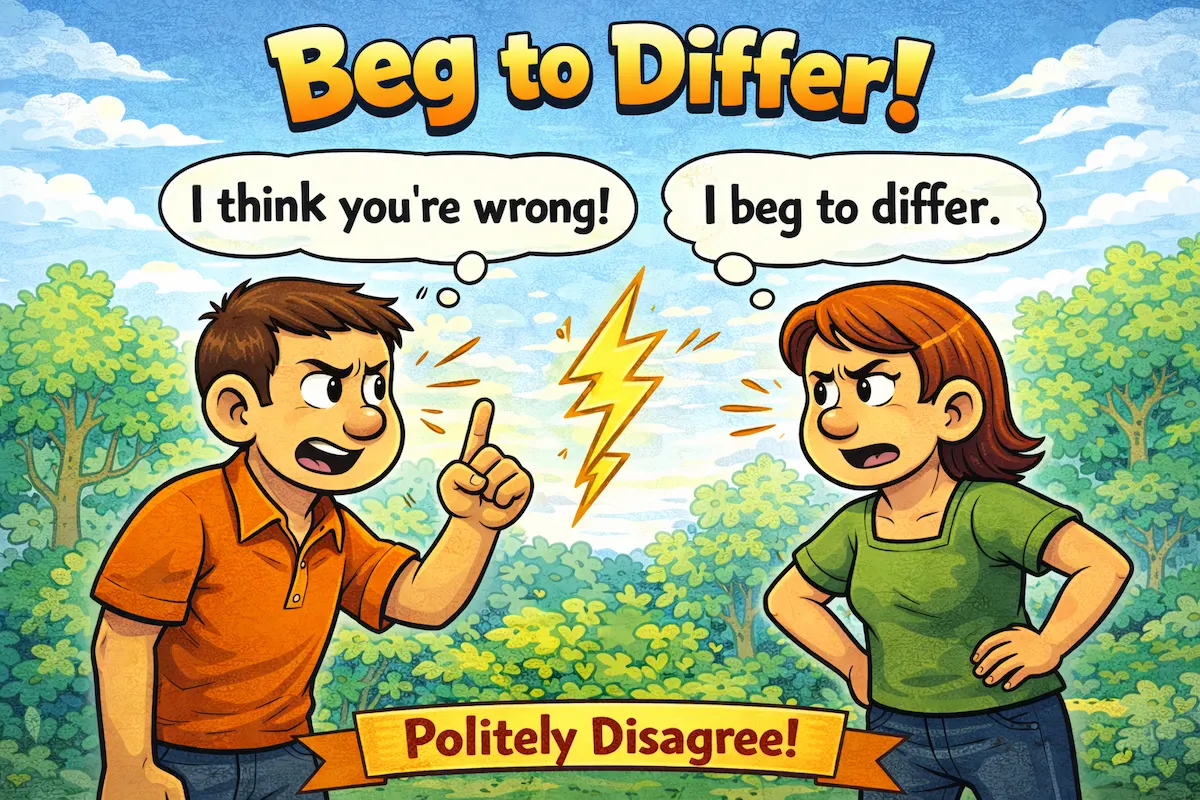
An Explanation of the Word "beg to differ" in an Image

Colorful landscape cartoon illustration of the idiom beg to differ, featuring two people disagreeing politely to represent expressing a different viewpoint in a respectful way.
A lively cartoon illustration explaining the idiom “beg to differ,” showing two people in a polite disagreement, symbolizing expressing a different opinion respectfully without causing conflict.

Conversation Using the Phrase Beg to differ

During a formal debate about urban planning, architects Arthur and Beatrice discuss the merits of a new skyscraper project. The conversation highlights the phrase beg to differ, a polite and formal way of saying that you disagree with someone’s opinion or statement.

Arthur: I think this glass tower will be a landmark for the city, but I suspect some residents might beg to differ.

Beatrice: I actually beg to differ with your assessment; I believe the building’s design is much too modern for this historic area.

Arthur: While you may feel it’s out of place, I beg to differ because the city needs to embrace future growth and innovation.

Beatrice: I read a critic's review who said the project was flawless, but most local historians would certainly beg to differ.

Arthur: If the mayor thinks the budget is sufficient, the financial committee will likely beg to differ once they see the actual costs.

Beatrice: I noticed that the contractors beg to differ regarding the timeline; they say it will take at least another year to complete.

Arthur: I saw a poll where half the town loved the idea, while the other half seemed to beg to differ quite strongly.

Beatrice: It’s a divisive issue, but it’s important to listen to those who beg to differ to reach a better compromise.

Arthur: I’m glad we can discuss this civilly even when we beg to differ on the fundamental design choices.

Beatrice: I agree; a healthy project always has room for those who beg to differ and offer a different perspective.

Phrases Containing the Expression Beg to Differ

The phrases below show how the expression beg to differ is used to politely disagree, express an opposing opinion, or challenge a statement without sounding rude.

Beg to differ

To politely disagree.

I beg to differ, because the data clearly shows a different trend than the one you described.

Beg to differ respectfully

To disagree with courtesy.

With all due respect, I beg to differ based on my experience working directly with customers.

Beg to differ on that point

To disagree on a specific issue.

I beg to differ on that point, as the evidence suggests a more complex explanation.

Beg to differ slightly

To disagree only a little.

I beg to differ slightly, since most of the plan actually works quite well.

Beg to differ strongly

To firmly disagree.

I beg to differ strongly, because this decision could affect thousands of people.

Beg to differ from that view

To oppose an opinion.

I beg to differ from that view after reviewing the long-term consequences.

Beg to differ in a discussion

To express disagreement in conversation.

During the discussion, she politely begged to differ and explained her reasoning calmly.

Beg to differ with the conclusion

To disagree with a final judgment.

I beg to differ with the conclusion, as it overlooks several key factors.

Beg to differ based on experience

To disagree using personal knowledge.

I beg to differ based on experience, having worked in this field for over a decade.

Beg to differ politely in public

To disagree openly but politely.

She begged to differ politely in public without embarrassing anyone.

Beg to differ during a debate

To challenge an argument.

He begged to differ during the debate and backed his point with solid facts.

Beg to differ quietly

To disagree without confrontation.

She begged to differ quietly and chose not to push the issue further.

Beg to differ with confidence

To disagree assertively.

He begged to differ with confidence, making his position very clear.

Beg to differ from popular opinion

To oppose a widely held belief.

I beg to differ from popular opinion, as trends don’t always reflect reality.

Beg to differ in principle

To disagree on fundamental grounds.

I beg to differ in principle, even if the outcome seems appealing.

Beg to differ with respect

To disagree politely.

I beg to differ with respect, but I see the situation very differently.

Beg to differ after reflection

To disagree after thinking carefully.

After reflection, I beg to differ with the original assessment.

Beg to differ during negotiations

To disagree in bargaining.

She begged to differ during negotiations and suggested an alternative solution.

Beg to differ calmly

To disagree without emotion.

He begged to differ calmly, keeping the conversation productive.

Beg to differ openly

To express disagreement clearly.

I beg to differ openly, because silence would imply agreement.

Words Rhyme with beg to differ

egg to sniffer
leg to stiffer
peg to griffer
keg to skiffer
meg to sniffer
reg to differ
said to suffer
led to rougher
fed to tougher
bed to puffer
differ
stiffer
sniffer
griffer
skiff
cipher
liver
river
shiver
sliver
quiver
deliver
consider
glitter
bitter
litter
critter
skitter
fritter
twitter
POS: Verb Phrase