How to End a Presentation: "That's it" vs. "This concludes my presentation"
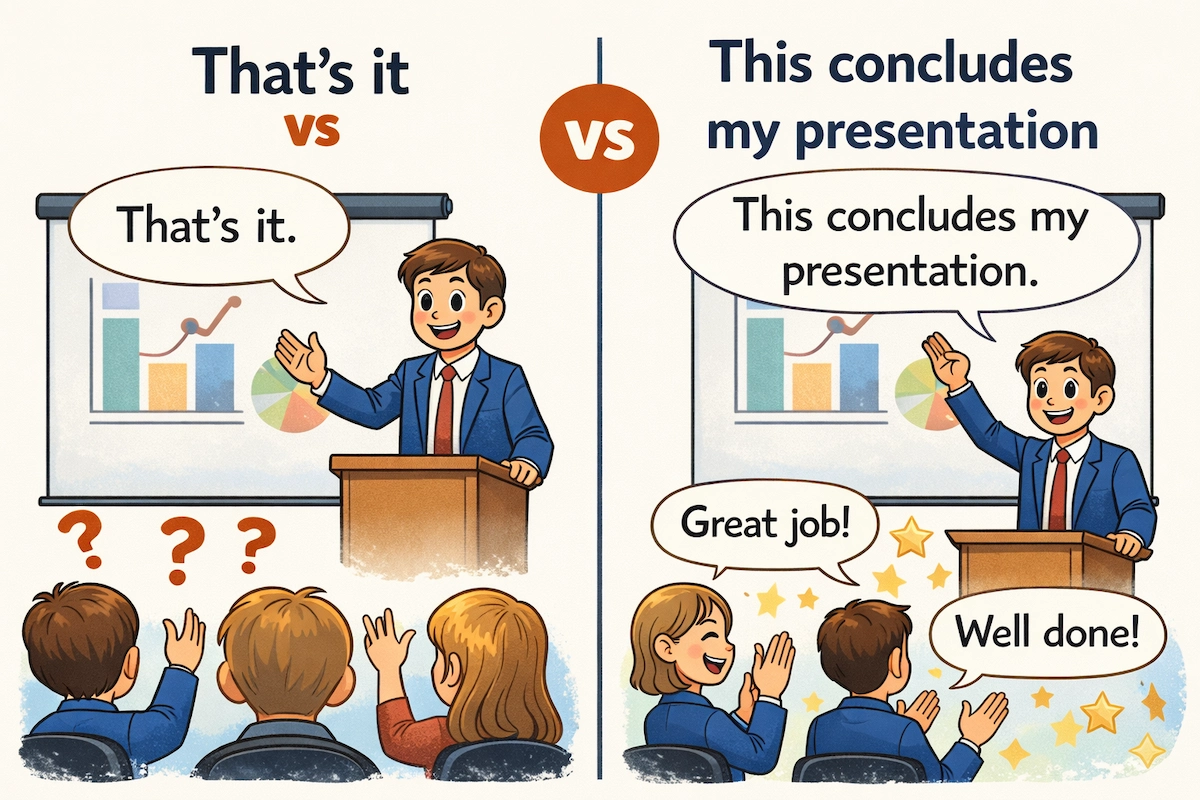
This Formal vs Informal usage guide explains how to end a presentation effectively. Learn why “That’s it” sounds too casual, explore professional closing patterns like “This concludes my presentation,” and master how to summarize, thank your audience, and invite questions with confidence.
Ending a presentation is just as important as starting one. You may have delivered strong content, clear visuals, and solid data — but if your closing feels weak, abrupt, or awkward, the audience’s final impression suffers.
Many English learners end presentations with a simple phrase like “That’s it”. While this is not grammatically wrong, it often sounds too casual, unfinished, or even dismissive in professional or academic settings.
In this usage guide, we’ll compare informal and formal ways to end a presentation, explain why “This concludes my presentation” sounds more professional, and show you practical sentence patterns to close with confidence, clarity, and impact.
Why the Ending of a Presentation Matters
Psychologically, people remember the beginning and the end of a presentation more than the middle.
A strong closing helps the audience:
- Understand your key message
- Feel that the presentation is complete
- Know what happens next (questions, discussion, action)
The language you choose at the end signals professionalism, confidence, and respect for your audience.
Why “That’s It” Often Sounds Weak
The phrase “That’s it” is extremely common in casual conversation.
Okay, that’s it.
In informal situations, this works fine. But in a presentation, it can sound:
- Unprepared
- Too abrupt
- As if the speaker ran out of things to say
It doesn’t guide the audience or acknowledge their attention.
When “That’s It” Is Acceptable
There are limited contexts where “That’s it” is acceptable:
- Very informal team updates
- Internal meetings with close colleagues
- Casual brainstorming sessions
That’s it from me — let’s move on.
Even then, adding context improves clarity.
Why “This Concludes My Presentation” Sounds Professional
“This concludes my presentation” clearly signals closure.
This concludes my presentation.
It tells the audience:
- The main content is finished
- The structure was intentional
- The speaker respects formal conventions
This phrase is neutral, professional, and widely accepted in business, academic, and conference settings.
Formal vs Informal: Side-by-Side Comparison
Informal: That’s it. Formal: This concludes my presentation.
Both indicate an ending, but only the second carries authority and polish.
Sentence Pattern: Signaling the End
Common formal closing patterns include:
- This concludes my presentation.
- That brings me to the end of my presentation.
- This marks the end of today’s presentation.
These patterns explicitly guide the audience.
Adding a Summary Before You Close
Strong presenters often summarize before ending.
To summarize, we’ve discussed the main challenges, proposed solutions, and expected outcomes.
This reinforces your message and prepares the audience for closure.
Formal Summary + Closing Pattern
To summarize, we’ve reviewed the current situation and outlined our next steps. This concludes my presentation.
This structure sounds organized and confident.
Thanking the Audience Professionally
Gratitude is a key part of formal closings.
Thank you for your time and attention.
This acknowledges the audience’s effort and engagement.
Combining Closing + Thanks
This concludes my presentation. Thank you for your attention.
This is one of the most standard and safest professional endings.
Inviting Questions: The Right Way
Ending a presentation usually leads into a Q&A session.
I’d be happy to answer any questions you may have.
This sounds polite and open, without pressure.
Full Formal Closing Example
That brings me to the end of my presentation. Thank you for your time, and I’d be happy to answer any questions.
This closing is clear, respectful, and professional.
Common Learner Mistake #1: Ending Too Abruptly
Okay… that’s it.
This creates an uncomfortable pause and uncertainty.
Common Learner Mistake #2: Overly Casual Language
Yeah, so I guess that’s all.
Casual fillers weaken authority in formal contexts.
Adjusting Formality Based on Context
Not all presentations require the same level of formality.
Consider:
- Audience size
- Professional hierarchy
- Setting (meeting room vs conference)
Formal language is always safer when unsure.
Informal but Polished Alternatives
If full formality feels too stiff, try:
- That’s all I wanted to share today.
- That wraps up my presentation.
These sound natural while remaining professional.
Why Native Speakers Avoid “That’s It”
Native speakers associate presentations with structure and signaling.
A clear verbal marker helps the audience transition mentally.
“That’s it” lacks that clarity.
Practicing Your Closing
Your closing should feel as rehearsed as your opening.
Practice saying your final sentence out loud until it feels natural.
Final Thoughts: End with Intention
Ending a presentation is not just about stopping — it’s about closing the experience.
While “That’s it” may work in casual talk, professional settings call for clarity, respect, and structure.
By choosing formal closing patterns like “This concludes my presentation”, you leave your audience with confidence, credibility, and a strong final impression.