Role vs. Roll: Are You Acting or Just Moving Forward?
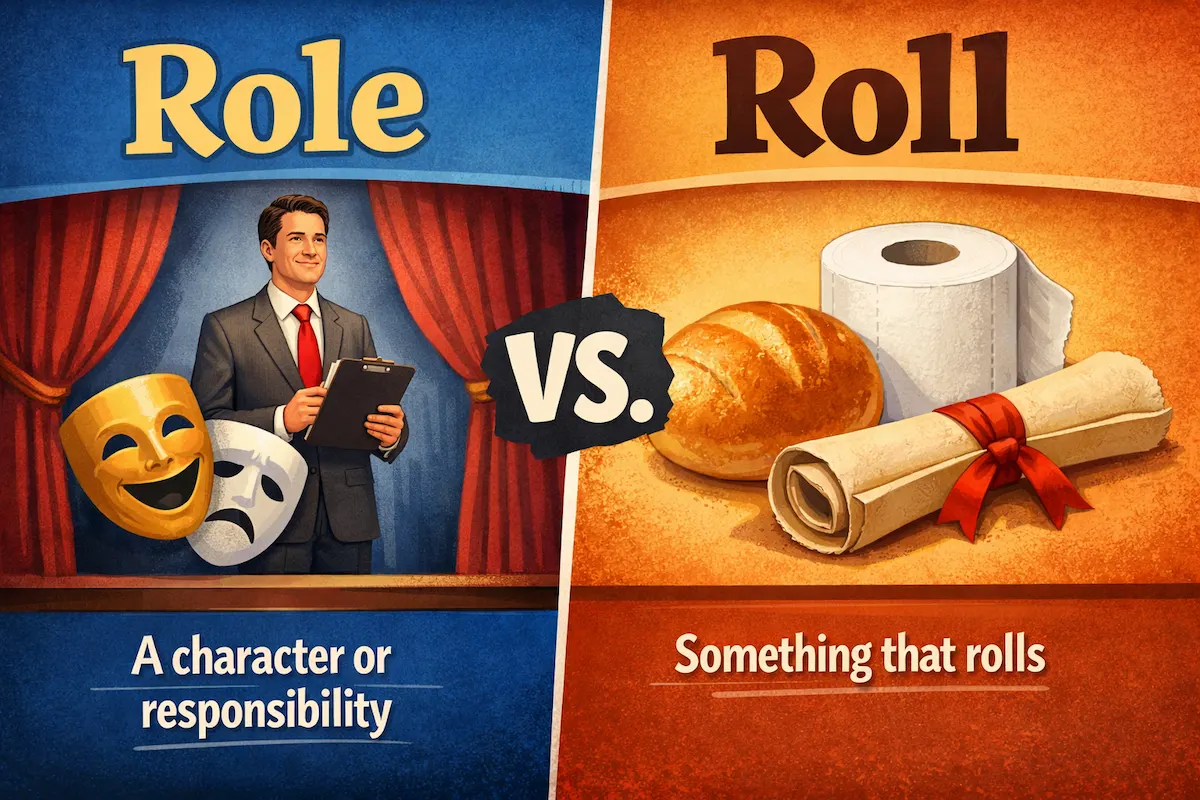
This guide explains the confusing words role and roll with clear definitions and examples. Learn how one refers to responsibility or acting while the other describes movement or physical objects, plus test yourself with practical exercises to avoid common mistakes.
English has a long list of words that sound identical but carry very different meanings. These sound-alike pairs are often harmless in speech, but in writing they can completely change your message if you choose the wrong spelling.
One of the most common — and surprisingly frequent — examples is role vs. roll. Depending on which one you use, you might be talking about acting in a movie, fulfilling responsibilities at work, moving forward physically, or even ordering food.
In this confusing words guide, we’ll break down the difference between role and roll, explore how each word is used in real contexts, and give you clear strategies to avoid mixing them up — once and for all.
Why Role and Roll Are So Commonly Confused
The confusion between role and roll exists for three main reasons:
- They are pronounced exactly the same
- Both are extremely common words
- Spellcheck rarely catches the mistake
Because your ear can’t tell the difference, you must rely on meaning and context when choosing the correct spelling.
What Does “Role” Mean?
Role refers to a function, position, or character that someone plays in a specific situation.
She played the role of the lead character in the movie.
A role is abstract — you cannot touch it or physically move it.
Common Contexts for “Role”
- Acting and theater
- Jobs and responsibilities
- Social positions
- Organizational functions
Communication plays a key role in successful teamwork.
Role in Professional and Academic English
“Role” is especially common in formal and semi-formal contexts.
The manager’s role includes coordinating between departments.
In these cases, role describes responsibility rather than action.
What Does “Roll” Mean?
Roll generally refers to movement, rotation, or something cylindrical in shape.
The ball began to roll down the hill.
Unlike role, roll is often physical and visible.
Roll as a Verb
As a verb, roll describes motion.
Please roll the suitcase into the room.
The action involves movement, usually in a smooth or circular way.
Roll as a Noun
As a noun, roll can refer to several physical objects or concepts.
- A small piece of bread
- A list of names
- A cylindrical shape
He ordered a soup and a bread roll.
Role vs. Roll: The Core Difference
Role = function, position, character Roll = movement, rotation, object
If it involves responsibility or identity, choose role. If it involves motion or something physical, choose roll.
How One Letter Changes the Meaning Completely
Compare these two sentences:
He accepted his new role at the company. He accepted his new roll at the company.
The first makes sense. The second sounds like a bakery delivery.
Why Spellcheck Often Fails Here
Both role and roll are correct English words.
Spellcheck checks spelling — not meaning. This makes role vs. roll errors especially dangerous in emails, essays, and professional writing.
Memory Trick: Think “Acting” vs. “Action”
A simple way to remember:
Role → Acting, responsibility Roll → Action, movement
If someone is doing something physically, roll is more likely.
Role in Idioms and Expressions
“Role” appears in many abstract expressions.
Play a role Have a role in something
These expressions always relate to influence or participation.
Roll in Idioms and Expressions
“Roll” appears in expressions involving motion or progress.
Let’s roll. On a roll.
These expressions suggest movement, momentum, or continuation.
Common Learner Mistakes
- Choosing spelling based on sound alone
- Not rereading sentences for meaning
- Assuming spellcheck will catch errors
Role vs. Roll in Creative Writing
In stories and scripts, the difference is crucial.
The actor struggled with his role. The actor struggled with his roll.
Only one of these makes narrative sense.
How Native Speakers Decide Instantly
Native speakers ask themselves:
Is this about responsibility or movement?
This single question usually solves the problem.
Practice Test
Please answer the following questions. To see the correct answer, please click the arrow icon.
She was offered a leading ____ in the new TV series.
Answer: role Explanation: Acting involves characters and responsibilities.
The children watched the ball ____ across the yard.
Answer: roll Explanation: This describes physical movement.
Which word refers to responsibility?
Answer: role Explanation: Roles describe functions or positions.
Which sentence is correct? A) He played an important roll in the project. B) He played an important role in the project.
Answer: B Explanation: Projects involve responsibility, not movement.
What does “let’s roll” suggest?
Answer: Moving forward or starting action. Explanation: The phrase uses roll as movement and momentum.
Final Thoughts: Meaning Comes Before Sound
Role and roll may sound identical, but they live in very different conceptual worlds — one in responsibility and identity, the other in motion and physical action.
When you focus on meaning instead of pronunciation, this confusing word pair becomes easy to master, and your writing instantly becomes clearer, more professional, and more confident.