Stop Saying "Maybe" – Use These 5 Professional Alternatives
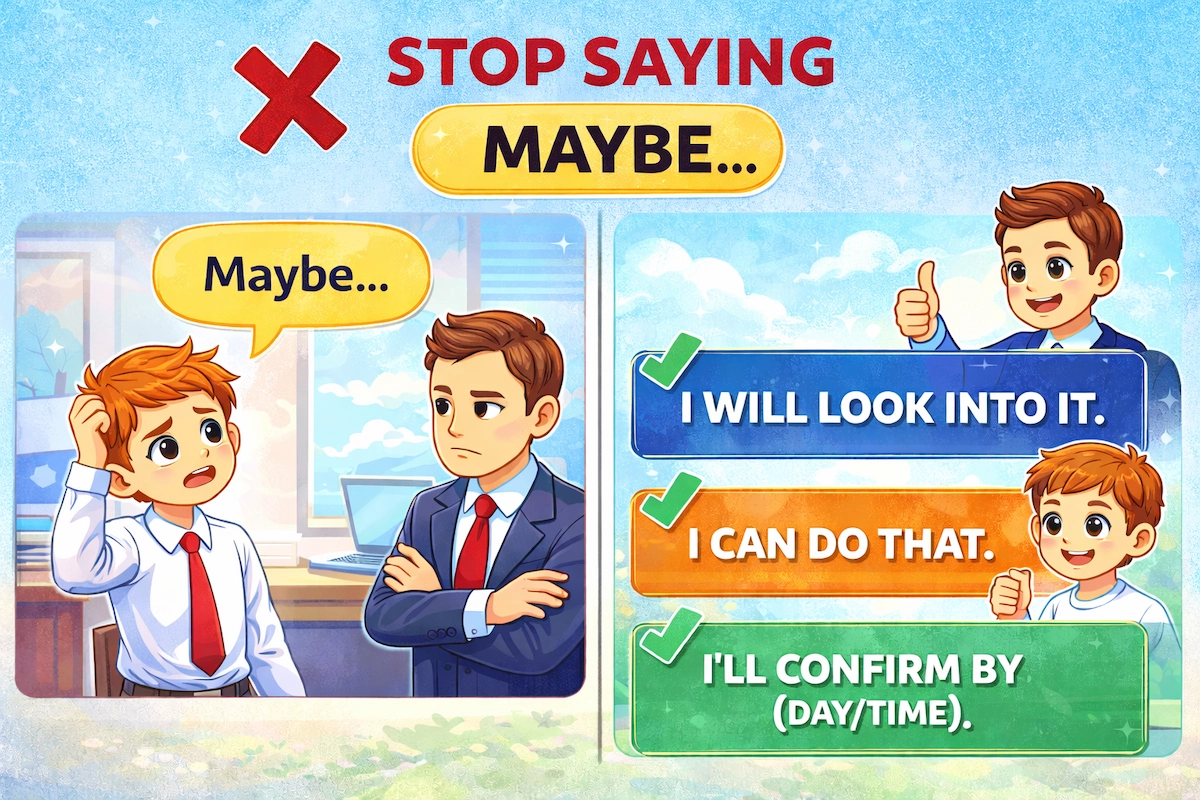
This Formal vs Informal usage guide explains why “maybe” sounds too casual in business communication. Learn five professional alternatives like “perhaps,” “it is possible that,” and “we may need to” to express uncertainty clearly and confidently in reports, emails, and meetings.
The word “maybe” is one of the first words English learners pick up. It’s short, flexible, and easy to use. In casual conversation, it works perfectly well. But in professional communication — especially in emails, reports, meetings, or presentations — “maybe” often sounds too vague, uncertain, or even careless.
In business contexts, language does more than share information. It signals confidence, responsibility, and decision-making ability. When you rely too heavily on “maybe,” your message can unintentionally suggest hesitation, lack of preparation, or avoidance — even if that’s not what you mean.
In this usage guide, we’ll explore why “maybe” sounds informal in professional settings and introduce five clear, formal alternatives you can use instead. These expressions allow you to communicate uncertainty without sounding unsure, unprepared, or unprofessional.
Why “Maybe” Sounds Weak in Professional English
The problem with “maybe” is not correctness — it’s tone.
“Maybe” is:
- Very casual
- Emotionally neutral
- Non-committal
In spoken English among friends, this is fine. In business writing, however, readers often expect:
- Clear probability
- Structured reasoning
- Measured confidence
“Maybe” rarely provides any of these.
Informal vs Formal Tone: A Quick Comparison
Informal: Maybe we can delay the launch. Formal: It may be possible to delay the launch.
Both sentences express uncertainty, but the second sounds deliberate and professional.
When “Maybe” Is Acceptable
It’s important to note that “maybe” is not forbidden.
It works well in:
- Casual conversations
- Brainstorming sessions
- Friendly internal chats
Maybe we should grab coffee later.
But once the message becomes official, written, or recorded, alternatives are safer.
Professional Alternative #1: “Perhaps”
“Perhaps” is the simplest formal replacement for “maybe.”
Perhaps we should review the proposal once more before submitting it.
Compared to “maybe,” “perhaps” sounds:
- More measured
- More thoughtful
- More neutral
It’s especially common in written English and formal discussions.
Professional Alternative #2: “It is possible that…”
This structure is ideal when you want to express uncertainty in a factual, analytical way.
It is possible that the delivery timeline will need to be adjusted.
This phrase:
- Removes personal hesitation
- Focuses on conditions
- Sounds objective
It’s particularly effective in reports and presentations.
Why This Sounds Professional
“It is possible that” frames uncertainty as a logical assessment rather than a personal guess.
This distinction matters in formal communication.
Professional Alternative #3: “There is a chance that…”
This phrase allows you to express probability without committing fully.
There is a chance that we may need additional resources for this phase.
It works well when discussing risk, planning, or forecasts.
Compared to “maybe,” it feels more transparent and deliberate.
Professional Alternative #4: “We may need to…”
Using may instead of “maybe” adds structure and authority.
We may need to revisit the budget assumptions.
This phrasing:
- Sounds proactive
- Suggests planning
- Implies responsibility
It’s very common in leadership communication.
Professional Alternative #5: “This could potentially…”
This option is useful when discussing impact or outcomes.
This could potentially affect our quarterly targets.
The word “potentially” softens the statement without weakening it.
It shows careful analysis rather than indecision.
Choosing the Right Alternative
The best replacement for “maybe” depends on:
- Formality level
- Written vs spoken context
- Audience seniority
- Degree of uncertainty
More formal contexts benefit from longer, structured phrases.
Common Learner Mistake #1
Informal email: Maybe we can move the meeting. Improved: Perhaps we could reschedule the meeting.
Common Learner Mistake #2
Report: Maybe sales will increase next quarter. Improved: It is possible that sales will increase next quarter.
Why Native Speakers Avoid “Maybe” in Reports
In formal writing, “maybe” feels conversational rather than analytical.
Native speakers instinctively replace it with:
- Modal verbs
- Probability phrases
- Conditional structures
These tools signal professionalism.
Using Formal Alternatives Without Sounding Stiff
Formal does not mean robotic.
Balance is key: use clear structure, but keep sentences natural.
Perhaps we could explore this option further.
This sentence sounds professional but human.
Practice Tip
Review your last email or report. Highlight every “maybe” and replace it with one of the alternatives above.
Notice how the tone changes immediately.
Final Thoughts: Certainty Is a Skill
Professional English isn’t about sounding perfect — it’s about sounding intentional.
By replacing “maybe” with clearer, more structured alternatives, you communicate confidence, thoughtfulness, and credibility.
You can still express uncertainty — just do it like a professional.