"Value" vs. "Valuable": Shifting Importance in Your Sentences
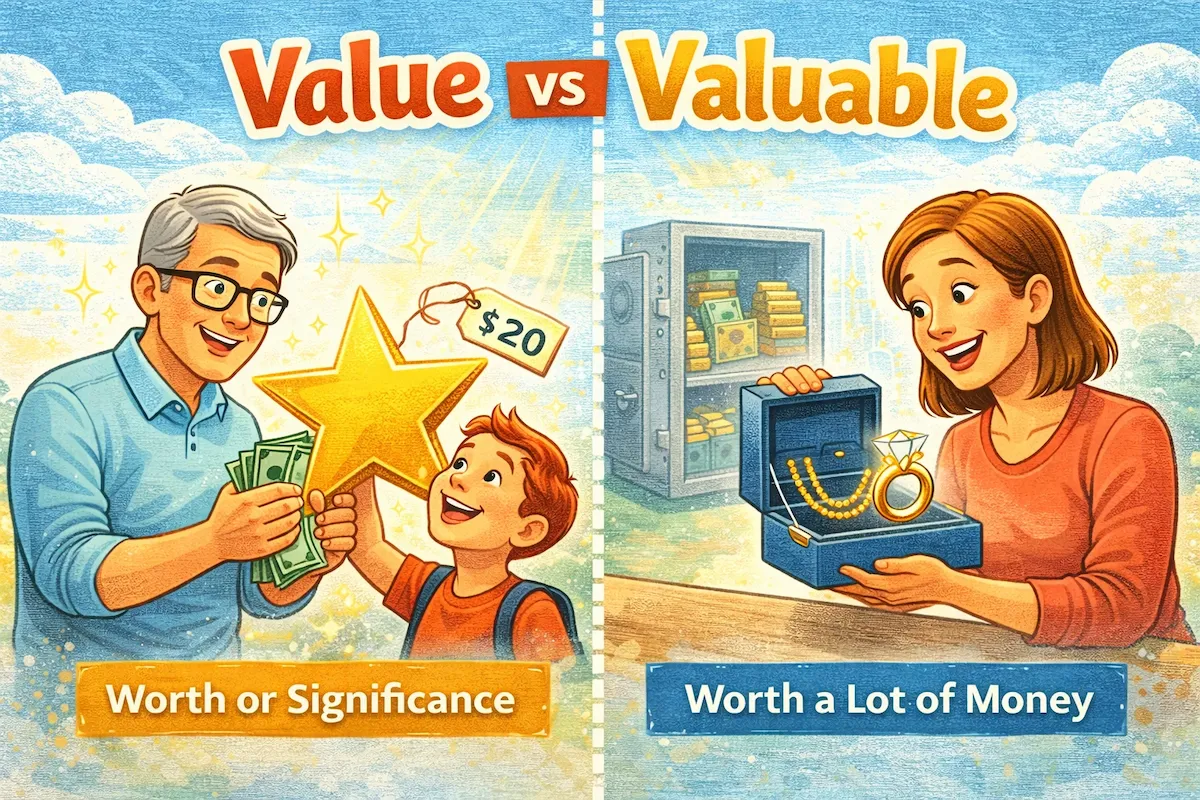
This sentence-patterns usage guide explains how “value” and “valuable” function differently as a noun and an adjective. Learn how sentence structure shifts meaning, see common mistakes, and master patterns that express importance clearly and naturally.
English learners often know the words value and valuable, but they don’t always know how to use them correctly in sentences. Because the words are closely related in meaning, many people assume they are interchangeable. In reality, they play very different grammatical roles.
A small shift from value to valuable can change the entire focus of a sentence. One highlights importance as an idea or principle, while the other highlights importance as a quality of something.
In this usage guide, we’ll explore the sentence patterns behind value and valuable, explain how noun–adjective shifts affect meaning, and help you choose the right form to sound precise and natural.
The Core Difference in One Line
Value is a noun (a thing or concept). Valuable is an adjective (a quality that describes a noun).
This difference controls where each word appears in a sentence.
What Does “Value” Mean?
Value is primarily a noun.
It refers to:
- Importance
- Worth
- Principles or beliefs
- Usefulness in an abstract sense
Honesty is a core value in our company.
Here, value represents an idea, not a physical property.
Common Sentence Patterns with “Value”
Because value is a noun, it appears in positions where nouns normally appear.
We place great value on teamwork. This policy reflects our values.
Notice how “value” can be singular or plural depending on meaning.
“Value” as a Verb (Secondary Use)
Value can also function as a verb, meaning “to consider important.”
We value your feedback.
This verbal use still focuses on importance, not description.
What Does “Valuable” Mean?
Valuable is an adjective.
It describes something as:
- Important
- Useful
- Worth a lot (financially or non-financially)
This experience was valuable.
The word modifies the noun or completes the sentence as a description.
Adjective Placement with “Valuable”
As an adjective, valuable can appear:
- Before a noun
- After a linking verb
She shared valuable advice. The advice was valuable.
Both structures are grammatically correct.
Why “Value” Cannot Replace “Valuable”
Learners sometimes try to use value as an adjective.
Incorrect: She gave me value advice. Correct: She gave me valuable advice.
English requires an adjective in this position.
Shifting Focus: Concept vs Quality
Compare these sentences:
Time has great value. Time is valuable.
The first emphasizes importance as an idea. The second emphasizes time as a useful resource.
Formal and Professional Usage
In business and academic writing, these words appear frequently.
Integrity is a key value of the organization. Her contribution was valuable to the project.
Mixing them up weakens clarity and professionalism.
Common Learner Mistake #1
Incorrect: This report has a lot of valuable. Correct: This report has a lot of value.
After “a lot of,” we need a noun, not an adjective.
Common Learner Mistake #2
Incorrect: Education is a valuable in society. Correct: Education is valuable in society.
The article “a” signals a noun, which doesn’t work here.
Value vs Valuable in Comparisons
Comparatives highlight the difference clearly.
This training adds value to the team. This training is more valuable than expected.
Each sentence uses the correct grammatical role.
Abstract vs Concrete Importance
Value often feels more abstract.
Valuable often feels more practical or immediate.
Trust has value in relationships. Trust is valuable when making decisions.
Sentence Transformation Trick
You can often convert one pattern into the other:
This skill has value. This skill is valuable.
The grammar changes, but the core idea remains.
Practice Test
Please answer the following questions. To see the correct answer, please click the arrow icon.
Which word fits: This lesson has great ___.
Answer: value Explanation: The sentence needs a noun.
Which word fits: Her advice was extremely ___.
Answer: valuable Explanation: The word describes “advice.”
Why is “a valuable” incorrect by itself?
Answer: Because valuable is an adjective. Explanation: Adjectives must modify a noun.
Which sentence is correct?
Answer: We place high value on honesty. Explanation: “Value” functions as a noun here.
Why This Distinction Matters
Using value and valuable correctly:
- Improves sentence structure
- Clarifies emphasis
- Signals advanced grammar awareness
These small distinctions separate fluent English from basic English.
Final Thoughts: Importance Has Forms
English allows you to express importance in different ways.
Value lets you talk about importance as an idea. Valuable lets you describe something as important.
Mastering this shift gives you more control over meaning, tone, and clarity in your sentences.